

Time for Teachers: Self-Assessment with Community Support as Individual Solutions

Recap: Systemic vs. Individual Problems and Solutions
In the first Time for Teachers blog, the distinction between systemic and individual problems and solutions was made. Systemic problems require organization- or system-wide approaches that impact a broader group and address biases and/or system limitations. The second blog in this series explains how agile meetings and pulse surveys can streamline meetings and keep track of teachers’ concerns, issues, and needs.
This third blog post will discuss the importance of self-assessment in addressing individual problems and solutions teachers face. This is not to say the onus of addressing challenges should fall squarely on the shoulders of individual teachers. Rather, teachers need a community of practice and support to help them identify solutions for problems they might face individually.
Power of Self-Assessment
Just as students have individualized needs, teachers do, too. Although there may be common problems and issues that teachers face in their everyday work, not all teachers feel the same way about them. In the world of mindfulness, there is often an emphasis on individual introspection and reflection.
The same approach could be applied for teachers facing a schedule and to-do list that is daunting and overwhelming. There are many apps or programs out there that teachers can use to track workflows, tasks, and responsibilities, but using pencil and paper may feel more manageable and actually be more efficient.
Using a single sheet of paper, a teacher could do a quick self-assessment of tasks they like, challenging tasks they face, possible tasks to eliminate, and focus areas to reflect on individually and with colleagues.
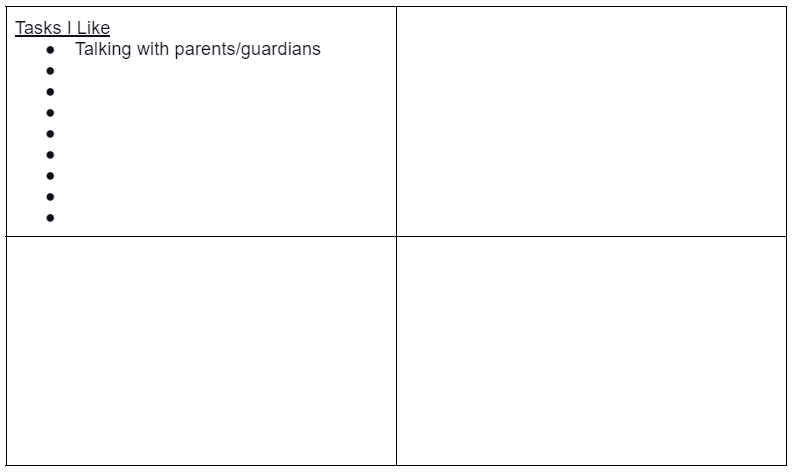
To start, one should draw two lines on the piece of paper to create four equally shaped rectangles. Each step of this self-assessment is illustrated below. Please note that the number of bullet points provided is for illustrative purposes only (there can be more or fewer bullets depending on what a teacher self-identifies).

In the upper left rectangle, one should write “Tasks I Like” and provide a bulleted list of the everyday tasks they enjoy and like to do. These tasks are the ideal things that a teacher would get to focus most of their time on.
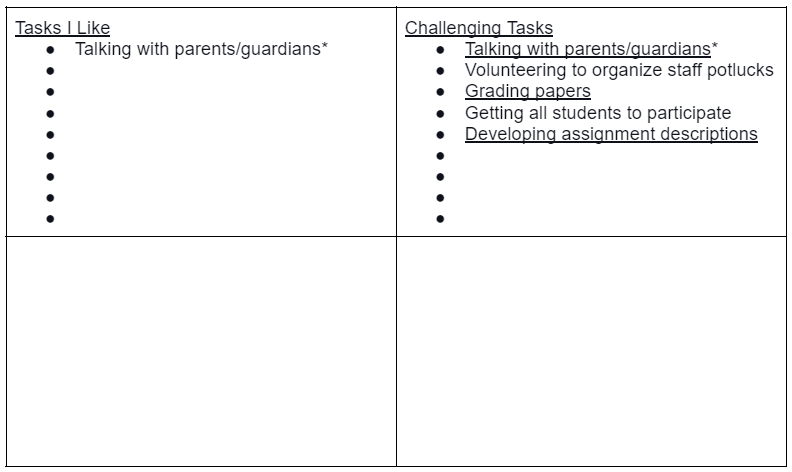
In the upper right rectangle, one should write “Challenging Tasks” and provide a bulleted list of the everyday tasks that might take up a lot of time and energy compared to others. One should underline the top one to three tasks that take the most time to complete. Before moving to the bottom of half of the page, one should put a star next to any tasks that overlap in the “Tasks I Like” and the “Challenging Tasks” list.
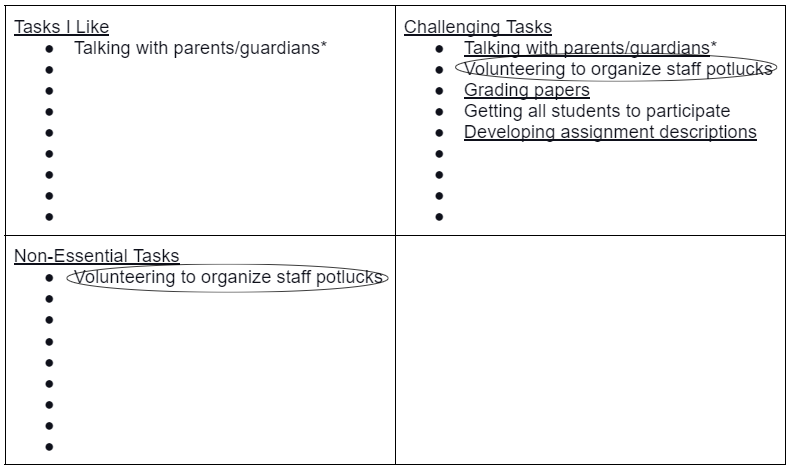
In the lower-left rectangle, one should write “Non-Essential Tasks” and provide a bulleted list of the everyday tasks that are not essential or not necessary to meet job requirements. One should compare the items listed under unnecessary tasks and challenging tasks. Any overlapping items should be circled.
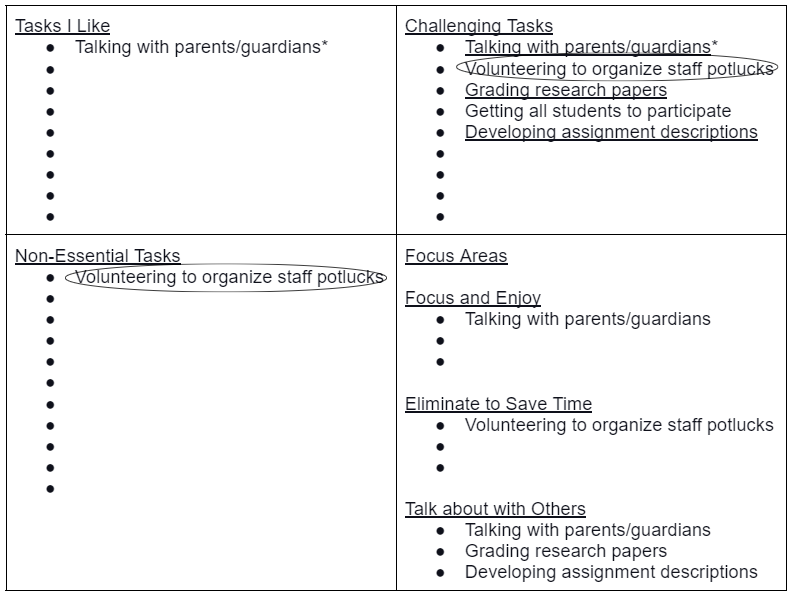
Finally, in the lower right rectangle, one should write “Focus Areas” and provide a bulleted list with three subheadings: (1) Focus and Enjoy (all of the starred items from the top half of the page), (2) Eliminate to Save Time (all of the circled items from the unnecessary task list), and (3) Talk about with Others (the underlined items from the challenging tasks list).
Teachers are encouraged to save their self-assessments in order to redo and compare them on a regular basis, perhaps once per semester or quarter, to see what changes over time. By taking 15-20 minutes to do an inventory like this, teachers can get an overview of what they like to do and strategic areas to focus on individually.
They can also target areas to talk with colleagues about using the physical document created. Colleagues could even share their self-assessments and seek advice on how to tackle challenging and time-consuming tasks.
Individual Enactment through a Community of Support
By going through a self-assessment inventory, teachers can prioritize their time to focus on what they like to do and what needs to be done. In any self-assessment, it is important for teachers to think about what could be discussed with a colleague. Discussing a list with a colleague, mentor, or administrator, will make identifying solutions more collaborative which can feel less overwhelming and isolating.
More independent teachers can certainly take initiative on their own but teachers are likely to feel more empowered to find innovative solutions when they work with a close colleague within a community of practice.
If it is challenging for teachers to collaborate with others in their immediate work environment, they could consider joining communities such as The Resilient Educator and Digital Promise’s EdCamp offering in-person and remote opportunities to meet with other teachers across the country to share experiences, effective practices, and possible solutions to particular problems.
Similar to the adage that it takes a village to raise children, it also takes a village for teachers to face and overcome the challenges of having limited time and resources at their disposal.
Final Thoughts
To help teachers feel satisfied with their work, they need to be given opportunities to assess what they like about teaching and how to address the individual problems they might be facing. If teachers find it difficult to carve out time to do a self-assessment, time could be dedicated for them to do so in a meeting or workshop that is already planned.
Having teachers conduct straightforward self-assessments together also builds trust. By giving teachers the chance to identify individual issues and connect them with possible solutions and resources within the systems and networks they work with, they will likely feel more empowered and supported.
Acknowledgments
The author would like to thank Christa Green, Kristen DeBruler, and Tracy Gieseking from the Michigan Virtual Learning Research Institute for their contributions and advice in writing this blog post.

Ed Timke
Dr. Ed Timke is a research specialist for Michigan Virtual. Although he specializes in qualitative research — such as interviews, focus groups, ethnographies, and textual and visual analyses — he was trained in mixed methods research while in his doctoral program in communication and media at the University of Michigan. Ed has taught online and face-to-face courses on writing, research methods, global media and communication, the role of advertising in society, and intercultural communication at American University, Duke University, UC Berkeley, and the University of Michigan.
Related Posts

From Simple Squares to Sweaters: How One Teacher Uses Crochet to Build Confidence
When Erica Gorzen’s students pick up a crochet hook, they choose their own path. Some make simple squares. Others create sweaters and stuffed toys. As the 2026-2027 Regional Teacher of the Year, this Portland High School art teacher shares how choice-based lessons help her students build confidence, independence, and a love of learning that lasts well beyond the classroom.
Build Trust, Boost Autonomy, & Design Smarter Check-Ins With Students
Strong student relationships don't happen by chance. They happen by design. Discover how structured check-ins can build trust, strengthen student autonomy, and help you create more student-centered learning experiences. Plus, access a free template or earn a SCECH while creating a check-in routine for your classroom.
Revisiting the 5:1 Ratio: Reflecting on a "Magic" Ratio Just Too Tidy to be True
A popular idea in education holds that teachers should aim for five positive interactions for every one corrective one. It spread quickly, cited widely, and seemed to just make sense. There was only one problem: the research behind it was never really about teaching at all.

Understanding How Students and Teachers Think About Responsible AI Use: An Interview with a Researcher
Students and teachers generally understand the risks of AI misuse, but they are less clear about what responsible AI-supported learning should look like in practice. This interview highlights findings from a Michigan Virtual study showing that students need clearer examples, consistent expectations, and practical guidance for using AI transparently and appropriately in schoolwork.
What Happens to Students' Online Course Scores After the Course Ends?
The moment an online course ends, a new question begins: how will that score be recorded locally? Drawing on a 2025 brief and a small follow-up survey, this blog post outlines three common approaches districts use to interpret and record students’ online course scores and why the differences can matter for students.

Everyone Has a Story
Learn how one Michigan educator helps students connect with each other and with the power of storytelling. Back when I began teaching...