
Did you know Michigan students have the legal right to take online courses?
In 2013, the Michigan Legislature expanded student access to digital learning options through Section 21f. As a result, students in grades 6-12 enrolled in a public school academy (PSA) or public local district (including students enrolled through a district on a part-time basis, such as those participating in a shared-time program) are eligible to enroll in up to two online courses during an academic term. It should be noted that districts do have the ability to deny the enrollment of K-5 students in online classes.
A student may be enrolled in more than two online courses if the student’s primary district determines that it is in the student’s best interest, the student agrees with the recommendation of the district, and the district and student have developed an education development plan that is kept on file by the district.
Section 21f Highlights
Michigan’s 21f legislation makes learning more affordable and accessible
Students are granted the opportunity to take additional courses online each semester
Online courses expand students’ potential by adding to their educational experience while making it convenient to retain success
Section 21f Resources
In 2013, the Michigan Legislature expanded student access to digital learning options through Section 21f. As a result, students in grades 6-12 enrolled in a public school academy (PSA) or public local district (including students enrolled through a district on a part-time basis, such as those participating in a shared-time program) are eligible to enroll in up to two online courses during an academic term. It should be noted that districts do have the ability to deny the enrollment of K-5 students in online classes.
A student may be enrolled in more than two online courses if the student’s primary district determines that it is in the student’s best interest, the student agrees with the recommendation of the district, and the district and student have developed an education development plan that is kept on file by the district.

Section 21f Legislation
Section 21f of the State School Aid Act contains language that outlines rights and responsibilities for K-12 virtual learning.
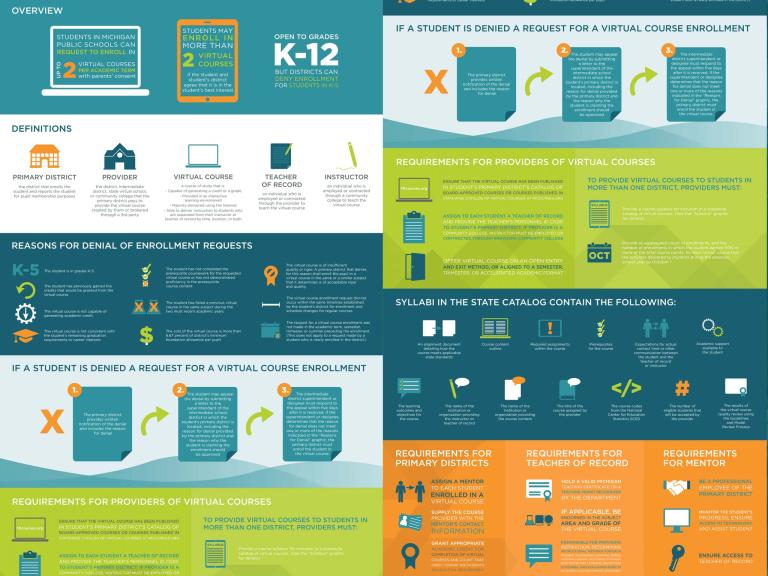
Section 21f Infographic
An infographic has been developed to provide a visual representation of the law.

Guide to Virtual Course Implementation
This guide provides an overview of the policies found in Section 21f of the State School Aid Act and identifies basic implementation decisions schools need to explore.

Michigan's Online Course Catalog
Michigan's Online Course Catalog is populated with course titles and syllabi submitted by local school districts, intermediate school districts and Michigan Virtual. Course syllabi include information such as course descriptions, course outlines, price and more.
Pupil Accounting Manual
Pupil membership requirements and count procedures for virtual learning are documented in Section 5-O-D of the Pupil Accounting Manual (PAM).
Role-Specific Guides
Additional guides have been developed specifically for students, parents, mentors, teachers, school board members, and administrators.
Planning Guide for Online and Blended Learning
A comprehensive guide for educational leaders who are tasked with integrating online and blended learning planning into the larger school improvement planning effort is also available.
Letters to Stakeholders (Samples)
To help educate important stakeholders about virtual learning options, several draft letters have been developed.
Mentor Resources
Even though courses are taught online, having support in the school building is important. Mentors are employed by the local school and act as that on-site support to online learners.
Checklist for Online Learning Coordinators
This resource contains a list of sample action items school counselors may want to consider as part of a planning checklist to manage student participation in online courses.
Online Learner Readiness Rubric
Students vary in their readiness for virtual learning. The Online Learner Readiness Rubric helps evaluate a student’s preparedness for virtual learning on eight dimensions.
Parent/Guardian Enrollment Request
Please fill out this form and alter the template to create a handout that your student can take to their counselor to let them know that your student is interested in taking online courses through Michigan Virtual.