

Portrait of a Graduate 101 Part 3

Part 3: Learning from District Experiences—Three Michigan Examples
Part 3 of a 4 Part Series for System-Level Leaders
By Dr. Tovah Sheldon & Dr. Sarah Pazur
In part one of this series, we explored what a Portrait of a Graduate is and why it matters now. In part two, we discussed why the POG process matters more than leaders often expect. We recommend that you review both parts before reading this article to lay a solid foundation for Portrait of a Graduate. Click here to review part one and here for part two.
By now, one thing should be clear: there is no single "correct" Portrait of a Graduate. Context matters. Community matters. Leadership matters.
Portraits of a Graduate exist across Michigan, the nation, and the world, and each reflects local values, aspirations, and realities. In fact,we regularly study Portraits from across systems using a weekly AI-aided scheduled task of newly published district work (a story for another day). For this article, however, we will focus on three Michigan districts: Boyne City Public Schools, Adrian Public Schools, and Fraser Public Schools.
These examples were selected not because they are flashy or perfect, but because we know their processes. We could get anyone’s final products from their websites, but you already know it is the process and the other paradoxes that make for the real change. Each of the district examples you will see below illustrates important lessons about how Portraits of a Graduate take shape over time, and what future superintendents can improve.
Case Study 1: Boyne City Public Schools
“Portrait of a Rambler”
Boyne City Public Schools took a distinctly local approach, developing what they call the “Portrait of a Rambler.” Rather than adopting generic graduate attributes, the district intentionally anchored its Portrait in community identity, place, and pride; a move that immediately increased relevance and ownership.
The Portrait of a Rambler reflects competencies such as adaptability, responsibility, and communication skills, and resonates deeply with the district’s rural Northern Michigan context. Importantly, the work did not live only on a webpage. Boyne City integrated the Portrait into community events, communications, and dialogue, using it as a living conversation starter rather than a static declaration.
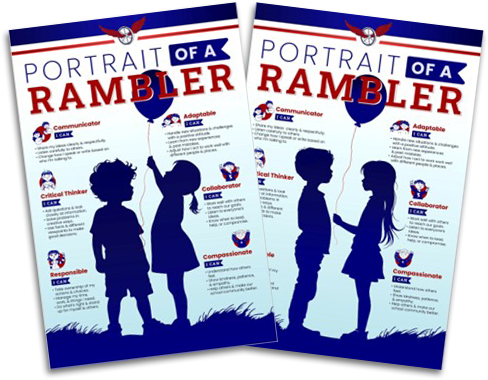
Youngest Learners and Upper Elementary
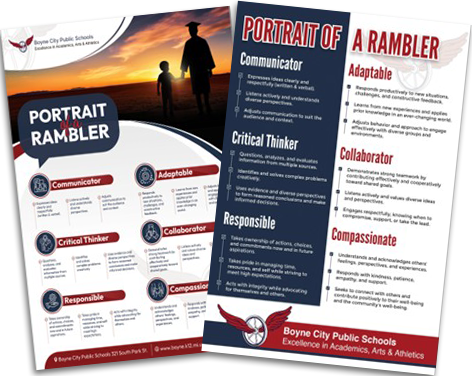
Middle and High Schools
Key leadership learning from Boyne City Public Schools:
- Local identity matters. Portraits gain traction when they sound like the community, not a consulting report.
- Naming matters. The language and branding (“Rambler”) helped shift the Portrait from an abstract framework to a shared story within the community.
- Visibility supports sustainability. When Portraits show up in everyday district life, they are more likely to endure. Boyne actually made different posters/graphics intentionally to feel more accessible and connected to the age range of students, like early childhood looks a little different than high school at first glance. However, the words on the page, the attributes themselves, are in fact identical. This strategic move supports unity and ownership.
References:
Boyne City Public Schools. (n.d.). Portrait of a Rambler.
https://www.boyne.k12.mi.us/
Case Study 2: Adrian Public Schools
Grounding Portrait Work in Strategic Renewal
Adrian Public Schools approached their Portrait of a Graduate as part of a broader district renewal and coherence effort. Rather than treating the Portrait as a standalone initiative, leaders intentionally connected it to instructional priorities, leadership expectations, and long-term planning.
What stands out in Adrian’s work is the deliberate pacing of the process. Stakeholder engagement was cultivated incrementally, allowing time for reflection, synthesis, and revision. Leaders recognized early that rushing to adoption would undermine trust and resisted that temptation.
The result was a Portrait that aligned clearly with district goals and served as a decision-making lens rather than an aspirational poster.
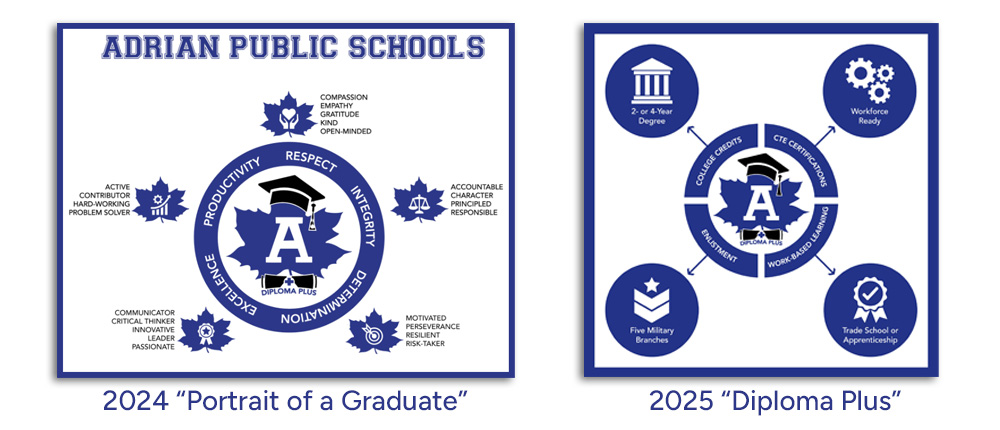
Key leadership learning from Adrian Public Schools:
- Alignment beats speed. A slower, more intentional process can actually accelerate long-term impact.
- Portraits should inform strategy, not sit beside it.
- Leadership restraint is a skill. Knowing when not to rush is as important as knowing when to move forward.
Reference:
Adrian Public Schools. (2023). Portrait of a Graduate.
https://www.adrianmaples.org/news/single.php?newsId=161
Case Study 3: Fraser Public Schools
Fraser Public Schools offers a strong example of clear communication and stakeholder transparency throughout the Portrait of a Graduate process. From early stages, the district made the purpose, timeline, and decision-making structure explicit, reducing confusion and building trust.
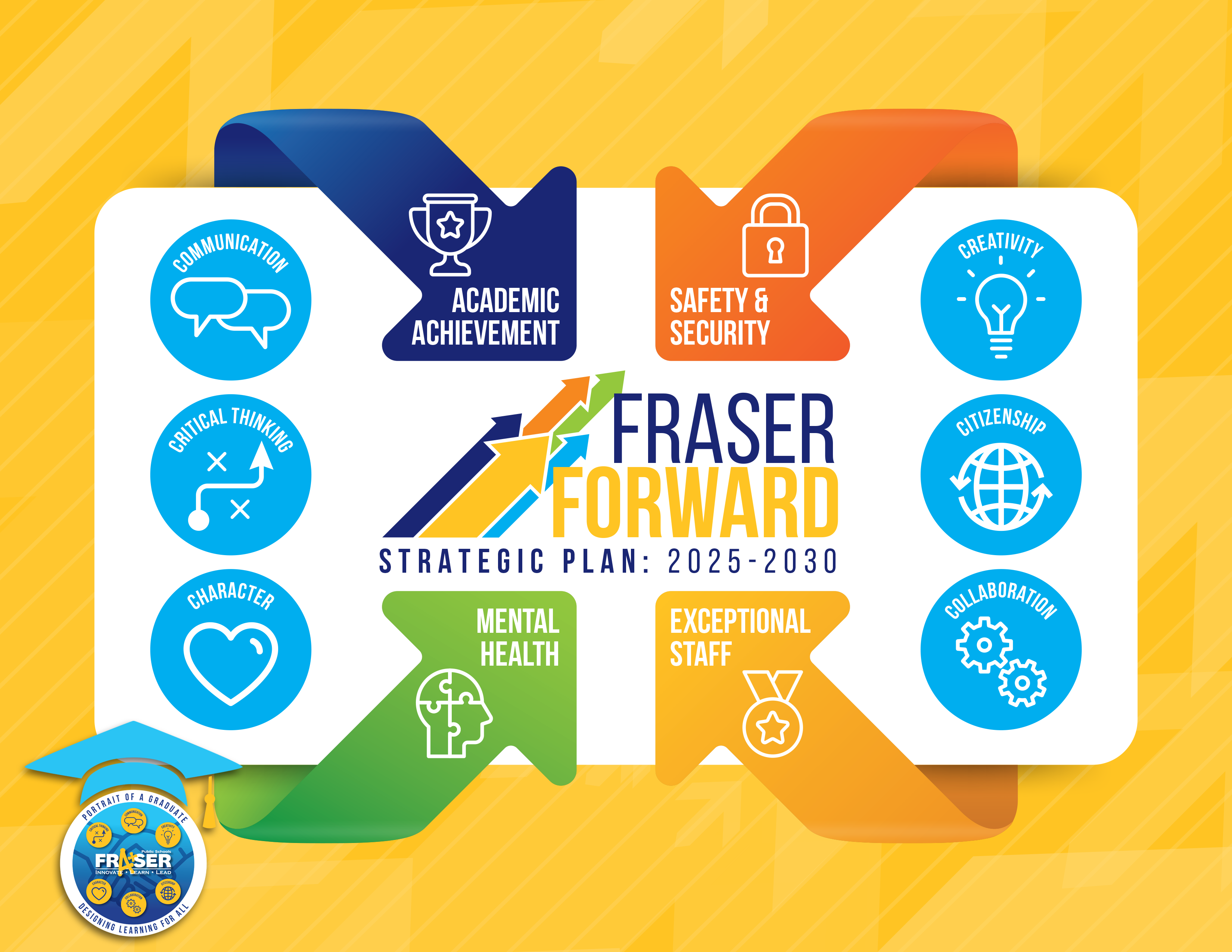
Key leadership learning from Fraser Public Schools:
- Transparency is not optional. Stakeholders disengage when they don’t understand how or why decisions are made.
- Clarity creates confidence. When people understand the process, they are more willing to engage honestly.
- Portraits work best when they simplify and do not complicate the system.
Reference:
Fraser Public Schools. (n.d.). Portrait of a Graduate.
https://www.fraser.k12.mi.us/departments/superintendent/portrait-of-a-graduate
Patterns Across Districts: Common Pitfalls Leaders Should Avoid
Regardless of size, geography, or governance, districts doing this work have named several recurring challenges.
1. Rushing the Process
Prioritizing speed over inclusion often leads to superficial buy-in. Leaders feel pressure to “get it done,” but rushed portraits rarely hold up under implementation.
Leadership takeaway:
Depth before deadlines. Inclusion before efficiency.
2. Lack of Transparency and Communication
When stakeholders don’t understand the process, they disengage, quietly defy, or stall out amidst the heart of the work.
Leadership takeaway:
Aim for clarity over compliance. Communication is not a side task; it is core leadership work.
3. Treating the Portrait as a Checklist or Poster
When Portraits are disconnected from daily practice, they quickly lose relevance.
Leadership takeaway:
A Portrait of a Graduate should function as a living framework, not a branding artifact. When you know your PoG without reading it, you’re living it. When someone else questions an action based on the competencies, you know it has become a way of work integrated into the education system authentically.
4. Misalignment with Strategic Priorities
Portraits that sit outside strategic plans, instructional priorities, or improvement efforts create confusion rather than coherence.
Leadership takeaway:
Alignment creates coherence over chaos. The Portrait should organize the work, not compete with it. Many things compete for your time, but this work should not compete with other priorities. It should complete and enhance those other things. Also, this work takes symphonic and systems thinking of individuals and collective groups to be done well.
5. Failing to Revisit and Iterate
Districts evolve. Communities change. Graduates encounter new realities. Portraits that remain static become obsolete. Why make the investment if there’s no plan to keep growing?
Leadership takeaway:
Effective leaders normalize iteration. A Portrait of a Graduate should be revisited periodically and evolve. The system that “knows better, needs to do better."
What These Districts Can Teach Us
Taken together, these examples reinforce a critical truth introduced in parts 1 and 2:
The power of a Portrait of a Graduate lies not in perfection, but in purposeful design, reflection, and adaptation.
Future superintendents do not need to avoid mistakes entirely, but they can learn from those who have gone before them. The districts highlighted here remind us that Portrait work succeeds when it is grounded in community, aligned with strategy, and treated as an evolving commitment rather than a finished product.
References & Further Resources
- Sheldon, T. (n.d.). Portrait of a Graduate design and system coherence practices. Michigan Virtual. https://michiganvirtual.org
- Boyne City Public Schools. (n.d.). Portrait of a Rambler. https://www.boyne.k12.mi.us
- Adrian Public Schools. (2023). Portrait of a Graduate. https://www.adrianmaples.org
- Fraser Public Schools. (n.d.). Portrait of a Graduate. https://www.fraser.k12.mi.us
- Pazur, S. & Sheldon, T. (2025, Dec. 11). Presentation: Future Ready by Design. MAPSA Symposium. Detroit, MI.
*Disclaimer: The graphics included in this content may have been created or enhanced using artificial intelligence–based tools.
About the Authors

Dr. Tovah Sheldon
Michigan Virtual School Design Strategist
For more than 20 years, Dr. Tovah Sheldon has served education as a teacher, professor, administrator, researcher, leadership coach, and consultant across pK-12 and higher education. She has a passion to cultivate constructive relationships, bring innovation to spaces that are managing complex change, and support implementation of evidence-based practices that promote equity and opportunity for all. Her demonstrated expertise ranges from curriculum, instruction, and assessment to professional development, capacity building, strategic planning, and system’s iteration for growth and sustainability. Dr. Sheldon has also served on various boards from within her community of Jackson and across the state of Michigan. Dr. Sheldon earned her Ph.D. from Michigan State University in Curriculum, Instruction, and Teacher Education.

Dr. Sarah Pazur
Director of School Performance at CS Partners
Dr. Pazur is the Director of School Leadership at CS Partners and a consultant with Michigan Virtual. Her education career spans over 20 years; she has served as a teacher, curriculum director, principal, and virtual principal in project-based middle and high schools across Detroit. She is a member of the Future of Learning Council; a national and local presenter, and her education writing has appeared in EdSurge, EdWeek, Education Post, Phi Delta Kappan, English Leadership Quarterly, Principal Leadership Magazine, and Hybrid Pedagogy. Her chapter, “A Bridge Across Our Fears: Poetic Imagination as a Catalyst for School Change,” appears in the book Cultivating Imagination in Leadership, with Teachers College Press.

Michigan Virtual
For more than 27 years, Michigan Virtual has partnered with K–12 school districts across Michigan to expand learning opportunities for students and educators alike. Through our high-quality online courses, taught by Michigan-certified, highly qualified teachers, we empower students to learn anytime, anywhere. We also provide affordable, impactful professional development to help educators grow in their craft. Most recently, Michigan Virtual has been at the forefront of innovation and artificial intelligence in education, offering consultation services and professional learning to guide schools in thoughtfully integrating new technologies and learning pathways.
Related Posts

Choosing Your Next Right Move: How Metaphors Help District Leaders Build Alignment and Coherence in Their Complex Systems
Many districts are doing ambitious transformation work, yet one of the most common risks is not lack of effort. It is fragmentation. This article explores how alignment and coherence, brought to life through seven powerful metaphors, can help leaders see their systems more clearly and make better decisions about what to do next.
Beyond Resistance: Understanding & Using Change Sets to Support Transformation
Leading meaningful change requires more than the right mindset. It takes the right combination of skills, tools, coaching, and systems. Explore the Change Sets framework to uncover why transformation stalls, identify what people truly need to move forward, and lead change with greater clarity and purpose.
Portrait of a Graduate 201 Article 3
Many districts have already done the work of approving a Portrait of a Graduate, naming what they want students to know, do, and become. The harder question now is how that vision moves from approval into everyday practice.
Portrait of a Graduate 201 Article 2
Many districts have already done the work of approving a Portrait of a Graduate, naming what they want students to know, do, and become. The harder question now is how that vision moves from approval into everyday practice.
Portrait of a Graduate 201 Article 1
Many districts have already done the work of approving a Portrait of a Graduate, naming what they want students to know, do, and become. The harder question now is how that vision moves from approval into everyday practice.
Kinds of Thinking
We all have a default way of thinking and most of the time, we don’t even notice it. In a complex, fast-changing world, how we think matters just as much as what we think. Overusing one kind of thinking can quietly limit our decisions, our leadership, and our growth. Becoming more intentional about how we think is one of the most important shifts we can make.