

Portrait of a Graduate 101 Part 1

Part 1: What is a Portrait of a Graduate and What Should Leaders Know?
Part 1 of a 4 Part Series for System-Level Leaders
By Dr. Tovah Sheldon & Dr. Sarah Pazur
Across pK–12 systems, superintendents, central office, and other leaders are grappling with a persistent and urgent question:
"What does it mean for high school graduates to be future-ready?"
For decades, education systems have relied on familiar benchmarks such as test scores, credit accumulation, GPAs, and compliance with graduation requirements. While these measures still matter, they offer only a partial view of readiness. They struggle to capture what young people actually need to navigate a rapidly changing world shaped by artificial intelligence, economic uncertainty, social complexity, and global interdependence.
This gap between what we measure and what truly matters has led many districts to a powerful organizing idea: the Portrait of a Graduate (PoG).
Drawing on professional expertise, hundreds of conversations with educators and system leaders, and national research, this article offers a clear foundation for understanding what a Portrait of a Graduate is, why it matters now, and what education leaders should know before launching or revisiting this work.
This gap between what we measure, and what truly matters has led many districts to a powerful organizing idea:
The Portrait of a Graduate (PoG)
What Is a Portrait of a Graduate?
Well, it actually goes by many names: Portrait of a Graduate, Portrait of a Learner, Learner Profile, etc. At its core, a Portrait of a Graduate is a community-created, outward-facing articulation of the knowledge, skills, mindsets, and dispositions a school system commits to developing in every learner by graduation (Atwell & Tucker, 2024; Westrich, 2020).
A Portrait of a Graduate is not just an aspirational list of traits or a branding exercise. It is a living expression of a community’s shared values and beliefs about learning, identity, and the future, and must evolve as contexts, technologies, and societal needs change.
A Portrait of a Graduate names the durable, real-world competencies that prepare students for college. careers, citizenship and continued learning. These competencies are not skills to be checked off a list; they transcend arbitrary seat-time, making them worthwhile, lifelong pursuits that students and young adults must practice and refine over time.
When done well, a Portrait of a Graduate becomes a touchstone for decision-making across the education system.
Key Nuances to Understand
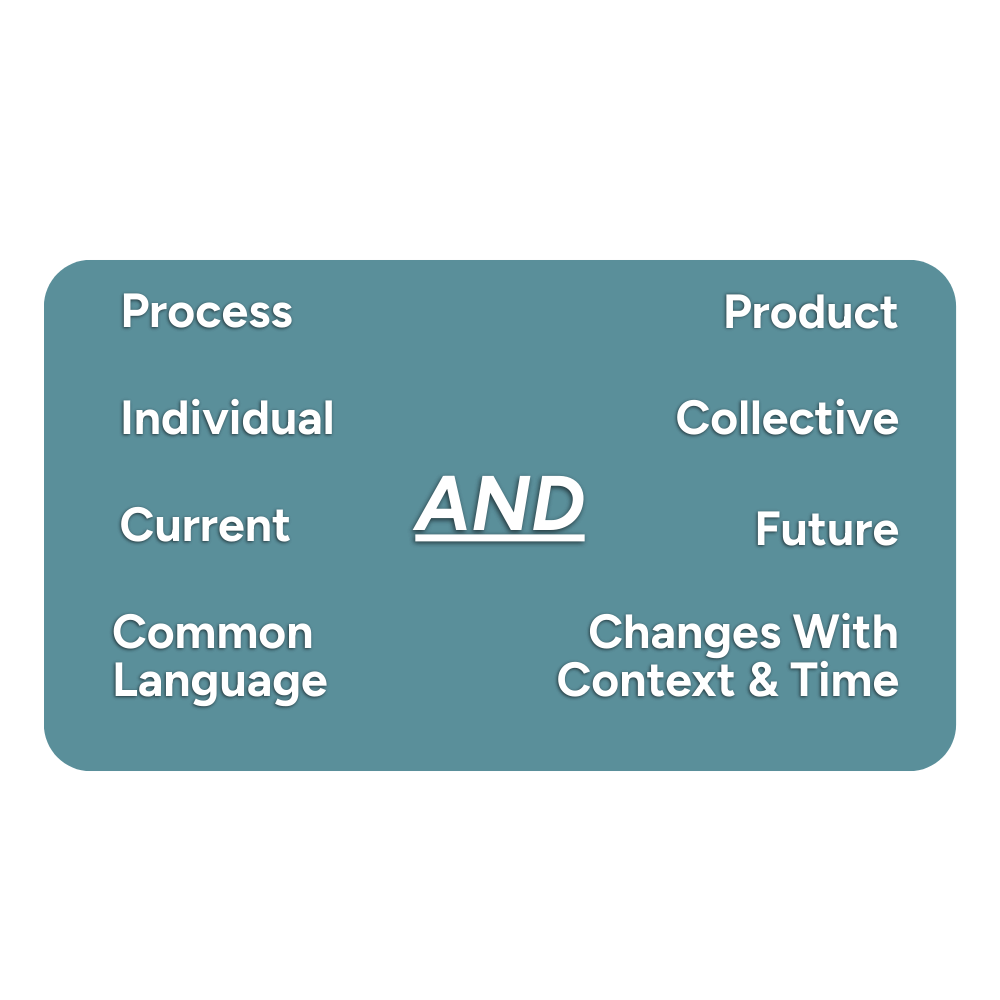
While the concept of a Portrait of a Graduate is relatively simple, its implications are not.
There are several nuances district and system leaders must consider.
1. It is Both a Process and a Product
Yes, the final product—a visual, framework, or statement—matters. It makes the vision visible and communicable. But the process of developing the Portrait is equally important, if not more so. The same competencies represented in a district’s Portrait of a Graduate should be exercised during its creation. If a district claims to value voice, collaboration, or critical thinking, those values should be clearly evident in how the Portrait is constructed. If communication, empathy, or problem-solving are likely to appear in the final Portrait, leaders should be able to point to where those same practices were modeled throughout the process.
The risk of not living and leveraging your stated values while you create your portrait is that you end up creating a portrait disconnected from your truth. That disconnect turns the final product into lip service rather than a lived commitment. This is one reason many districts benefit from skilled external facilitation—to help design an intentional, inclusive process that aligns means with ends.
2. It Honors the Individual and the Collective
A high-quality Portrait of a Graduate honors the contributions of individual stakeholders, specifically students, by including them in the creation process of the portrait. There are opportunities before, during, and after the process for individuals to provide ideas and feedback. It is critical that district and community members “see themselves” represented in the collective outcome.
During the implementation of the Portrait of a Graduate, individual students will have power over how they demonstrate each competency. This individual's lived expression of the portrait recognizes that every learner is unique, shaped by different experiences, identities, and aspirations. At the same time, the Portrait overall articulates shared commitments about what a community believes all graduates should be prepared to contribute to society.
This balance matters. A Portrait that is too individualized loses coherence, and one that is overly generic loses meaning. Effective Portraits hold both truths at once. In short, it is about unity, not uniformity, and individuals need to see themselves in the portrait to build collective efficacy and, eventually, collective agency.
3. It Is Rooted in the Present and Oriented Toward the Future
Strong Portraits of a Graduate make sense for students today, while remaining adaptable as contexts, technologies, and societal needs evolve. This flexibility is easier said than done. Many districts experience real tension between long-standing traditions and the accelerating pace of innovation. New technologies, shifting workforce demands, and social change can feel destabilizing, particularly in systems designed for predictability. Portraits of a Graduate do not eliminate this tension. Instead, they provide comfort and intentionality as you work through the paradox.
While communities and technologies evolve, portraits contain timeless skills that are trend-proof. Over 100 Michigan school districts with a Portrait of a Graduate name critical thinking as one of their competencies. Critical thinking’s intellectual roots are “as ancient as its etymology, traceable, ultimately, to the teaching practice and vision of Socrates over 2,500 years ago, who discovered by a method of probing questioning that people could not rationally justify their confident claims to knowledge” (Paul, Elder, & Bartell, 1997). In this way, a portrait of a graduate draws on time-tested pedagogy that remains relevant in 21st-century classrooms.
The opportunity for inverse investigation is also true; knowing the trends and future horizons while collectively building your portrait is important. For example, artificial intelligence is a part of our future (and current state) in some form or fashion. A key competency aligned to that future might be “agile design thinker” or “strategic decision maker.” Hence, your Portrait of a Graduate needs to be both rooted in the past and present, and oriented to the future.
4. It Creates Common Language and a Shared Way of Doing & Being
A Portrait of a Graduate gives educators, students, families, boards of education, and community partners a shared vocabulary for what success truly means.
This is more than semantics. In a system where attention is fragmented and priorities compete, a shared language enables coherence, ownership, and sustainability. Over time, the Portrait should become part of “how we do things here,” informing conversations, decisions, and compromises across the organization.
This Is pK–12 Work and Beyond
Portrait of a Graduate work does not begin in high school, nor does it end at graduation. It is a pK–12 commitment, shaping learning experiences across years. Even more powerful, strong processes intentionally gather insights from graduates after they leave the system in order to understand whether the Portrait remains relevant, where it holds true, and where it needs to evolve.
Many districts struggle to meet their goals due to a lack of alignment and shared meaning, not a lack of effort. A Portrait of a Graduate offers a way to unify that meaning across classrooms, schools, and communities.
One Foundational Lens for the Work: Know, Do, Be
In Part 2 of this 4-Part Series, we will discuss the importance of grounding the Portrait of a Graduate work in high-quality research and a variety of frameworks. One especially helpful organizing framework is the “Know, Do, Be,” adapted from the work of scholars such as Alison Fox Resnick (2023), Etienne Wenger (1998), and James Paul Gee (2000).
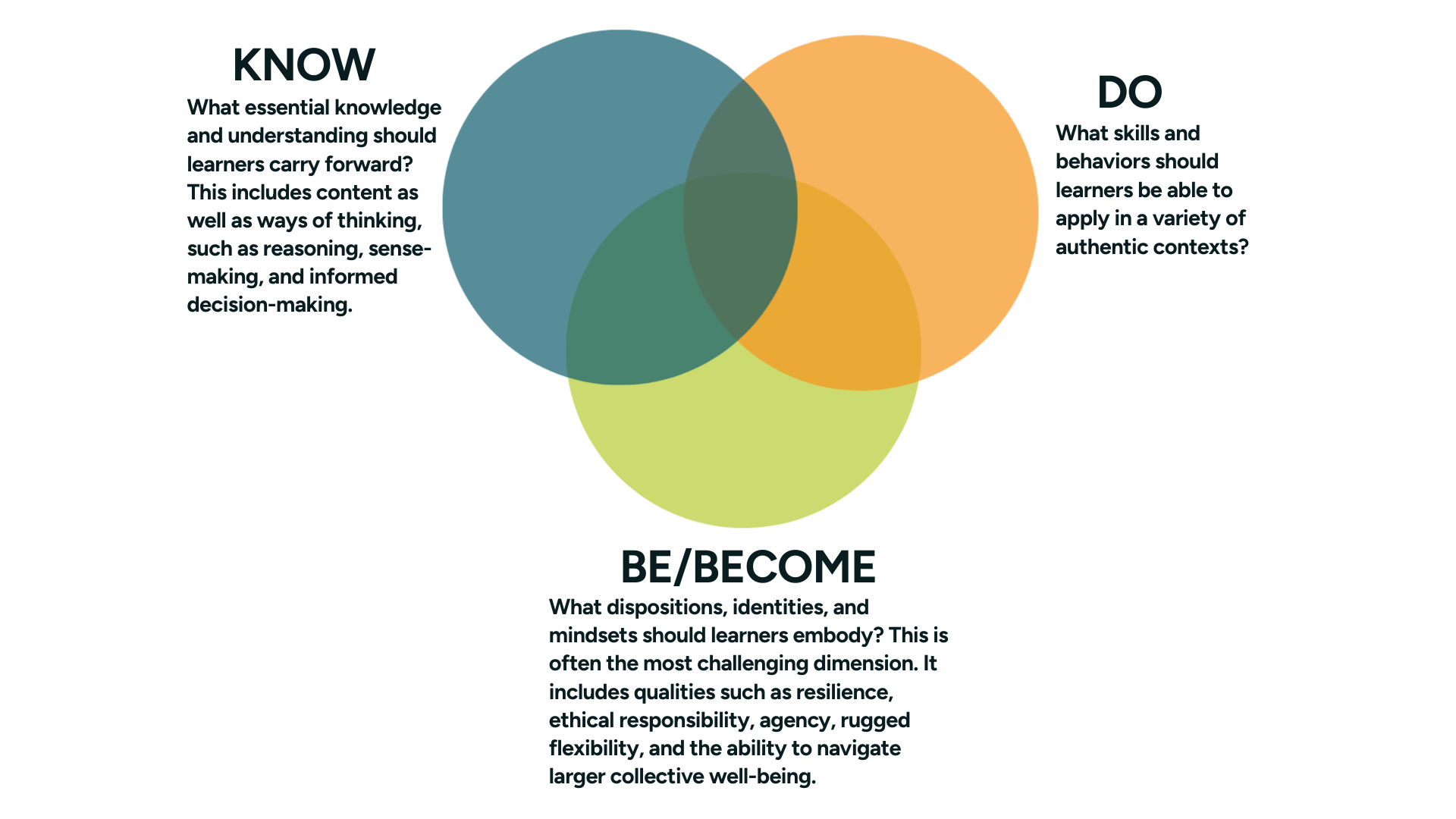
Know
What essential knowledge and understanding should learners carry forward? This includes academic content and ways of thinking, such as reasoning, sense-making, and informed decision-making.
Do
What skills and behaviors should learners be able to apply in authentic contexts? Think of competencies often labeled “soft skills,” which are anything but soft! A few we’ve all heard are collaboration, communication, problem-solving, and adaptability. The point of this frame is to consider what students can and will actually do, especially in our rapidly changing, ever-complex world.
Be/Become
What dispositions, identities, and mindsets should learners embody? This is often the most challenging and most important dimension. It includes qualities such as resilience, ethical responsibility, agency, rugged flexibility, and the ability to navigate systems, power, and one’s role in shaping change.
This framework pushes leaders beyond “content coverage” toward identity formation and learner agency. It invites reflection not just on what students can reproduce on demand, but on who they are becoming.
While Know–Do–Be is not the only framework informing Portrait of a Graduate work, it is a powerful and accessible entry point for system-level conversations.
Why a Portrait of a Graduate Matters Right Now
Education leaders frequently describe feeling overwhelmed by multiple initiatives, including strategic plans, accountability systems, mandates, innovation efforts, and community expectations. A well-designed Portrait of a Graduate does not add “one more thing.” Instead, it functions as the key star in a constellation that makes the whole sky make sense! The Portrait of a Graduate aligns and organizes the educational ecosystem and the greater landscape.
From an education system perspective, a Portrait of a Graduate can:
Anchor strategic planning and continuous improvement
Guide curriculum, instruction, and assessment as a shared touchstone
Shape professional learning and leadership development
Clarify graduate readiness and learner progressions for families and community partners
National research reinforces this shift. The Carnegie Foundation synthesized major competency-based education frameworks and identified 30 essential skills spanning cognitive, behavioral, and affective domains (Carnegie Foundation, 2022). Similarly, research from ETS about skills-based assessment highlights competencies such as collaboration, communication, empathy, creativity, and systems thinking—areas often underrepresented in traditional accountability models (Liu et al., 2023).
In short, a Portrait of a Graduate helps systems answer not just:
“Did students pass?” but two far more consequential questions:
“Who are students becoming?”
and
“Is that what the world [and/or our community] needs?”
References & Further Resources
Atwell, M.N & Tucker, A. (2024). Portraits Of A Graduate Strengthening Career And College Readiness Through Social And Emotional Skill Development. In partnership between CASEL & CIVIC Retrieved from: https://files.eric.ed.gov/fulltext/ED641286.pdf#:~:text=The%20portrait%20of%20a%20graduate,education%2C%20personal%20lives%2C%20or%20communities.
California Teacher Preparation for Instruction in Critical Thinking: Research Findings and Policy Recommendations: State of California, California Commission on Teacher Credentialing, Sacramento, CA, March 1997. Principal authors: Richard Paul, Linda Elder, and Ted Bartell
Carnegie Foundation for the Advancement of Teaching. (2022). Competency-based education frameworks. https://www.carnegiefoundation.org
Dunbar, Mandell, Swavely, Mills, & Baker. (2024, Nov. 25) Making a Portrait of a Graduate Authentic and Dynamic. Aurora Institute. Retrieved from https://aurora-institute.org/cw_post/making-a-portrait-of-a-graduate-authentic-and-dynamic/
Gee, J. P. (2000). Identity as an analytic lens for research in education. Review of Research in Education.
Liu, O. L., Kell, H. J., Liu, L., et al. (2023). A new vision for skills-based assessment. Educational Testing Service. https://www.ets.org/pdfs/rd/new-vision-skills-based-assessment.pdf
Pazur, S. & Sheldon, T. (2025, Dec. 11). Presentation: Future Ready by Design. MAPSA Symposium. Detroit, MI.
Resnick, A. F. (2023). Professional Identity as an Analytic Lens for Principal Learning in Contexts of Transformation. Educational Administration Quarterly, 59(5), 1038-1072. https://doi.org/10.1177/0013161X231204883 (Original work published 2023)
Sheldon, T. (n.d.). Portrait of a Graduate design principles and system-level facilitation. Michigan Virtual. https://michiganvirtual.org
Wenger, E. (1998). Communities of practice: Learning, meaning, and identity. Cambridge University Press.
Westrich, K. (2020, May 28). Portrait of a Graduate and the Promise Behind a Diploma. Knowledgeworks. Retrieved from https://knowledgeworks.org/resources/portrait-graduate-promise-diploma/
About the Authors

Dr. Tovah Sheldon
Michigan Virtual School Design Strategist
For more than 20 years, Dr. Tovah Sheldon has served education as a teacher, professor, administrator, researcher, leadership coach, and consultant across pK-12 and higher education. She has a passion to cultivate constructive relationships, bring innovation to spaces that are managing complex change, and support implementation of evidence-based practices that promote equity and opportunity for all. Her demonstrated expertise ranges from curriculum, instruction, and assessment to professional development, capacity building, strategic planning, and system’s iteration for growth and sustainability. Dr. Sheldon has also served on various boards from within her community of Jackson and across the state of Michigan. Dr. Sheldon earned her Ph.D. from Michigan State University in Curriculum, Instruction, and Teacher Education.

Dr. Sarah Pazur
Director of School Performance at CS Partners
Dr. Pazur is the Director of School Performance at CS Partners. She holds a Ph.D. in Educational Leadership from Oakland University and an MA in Curriculum and Instruction from the University of Detroit Mercy. Dr. Pazur has served as a teacher, curriculum director, principal, and virtual principal in project-based middle and high schools across Detroit. Dr. Pazur is a member of the Future of Learning Council; a national and local presenter, and her education writing and scholarship has appeared in several publications, most recently in Reconceptualizing Education Research Methodology.

Michigan Virtual
For more than 27 years, Michigan Virtual has partnered with K–12 school districts across Michigan to expand learning opportunities for students and educators alike. Through our high-quality online courses, taught by Michigan-certified, highly qualified teachers, we empower students to learn anytime, anywhere. We also provide affordable, impactful professional development to help educators grow in their craft. Most recently, Michigan Virtual has been at the forefront of innovation and artificial intelligence in education, offering consultation services and professional learning to guide schools in thoughtfully integrating new technologies and learning pathways.
Related Posts

Choosing Your Next Right Move: How Metaphors Help District Leaders Build Alignment and Coherence in Their Complex Systems
Many districts are doing ambitious transformation work, yet one of the most common risks is not lack of effort. It is fragmentation. This article explores how alignment and coherence, brought to life through seven powerful metaphors, can help leaders see their systems more clearly and make better decisions about what to do next.
Beyond Resistance: Understanding & Using Change Sets to Support Transformation
Leading meaningful change requires more than the right mindset. It takes the right combination of skills, tools, coaching, and systems. Explore the Change Sets framework to uncover why transformation stalls, identify what people truly need to move forward, and lead change with greater clarity and purpose.
Portrait of a Graduate 201 Article 3
Many districts have already done the work of approving a Portrait of a Graduate, naming what they want students to know, do, and become. The harder question now is how that vision moves from approval into everyday practice.
Portrait of a Graduate 201 Article 2
Many districts have already done the work of approving a Portrait of a Graduate, naming what they want students to know, do, and become. The harder question now is how that vision moves from approval into everyday practice.
Portrait of a Graduate 201 Article 1
Many districts have already done the work of approving a Portrait of a Graduate, naming what they want students to know, do, and become. The harder question now is how that vision moves from approval into everyday practice.
Kinds of Thinking
We all have a default way of thinking and most of the time, we don’t even notice it. In a complex, fast-changing world, how we think matters just as much as what we think. Overusing one kind of thinking can quietly limit our decisions, our leadership, and our growth. Becoming more intentional about how we think is one of the most important shifts we can make.