

Leadership Coaching for Innovation Part 1

Part 1: Innovator's Journeys as the Foundation for Leadership Coaching for Innovation
Part 1 of a 3 Part Series
By Dr. Tovah Sheldon
Before we define Leadership Coaching for Innovation as a specialized form of coaching, it is important to begin with the larger story of innovation itself. At Michigan Virtual, we’ve named this "Innovator’s Journeys."
That framing matters because innovation in education is often misunderstood. Too often, leaders hear the word innovation and think first of a new initiative, a new tool, a pilot program, or a polished success story. Yet meaningful innovation is not simply the adoption of something new. It is the disciplined, human-centered work of noticing needs, exploring possibilities, making sense of complexity, designing responsive solutions, learning through implementation, and adapting over time.
For educational leaders, that work is strategic, relational, and often messy. It requires leaders to navigate ambiguity while still helping people, systems, and ideas move forward. That is why the Michigan Virtual Innovator’s Journeys is such an important grounding framework for understanding innovation and, ultimately, for understanding why Leadership Coaching for Innovation matters so much.
Starting with a Research-Based Framework
The foundation for this way of thinking comes from The Henry Ford inHub’s Model i Learning Framework. Model i emerged from research that examined the stories, artifacts, and patterns of innovation found in The Henry Ford’s Archive of American Innovation and in the work of innovators across business, industry, and society. Rather than reducing innovation to a single formula, the framework identified recurring actions and habits that appear across generations of innovators.
That distinction is important. Innovation is not presented as a personality trait or a title. Instead, it is framed as something that can be better understood, intentionally developed, and meaningfully practiced.
Building on that research foundation, Michigan Virtual evolved the framework, resulting in Michigan Virtual’s Innovator’s Journeys. This improvement was designed specifically for leaders in education and continues to be field-tested every day in our education system. It broadens the conversation beyond habits and behaviors alone and surfaces a fuller range of competencies, including mindsets, skill sets, dispositions, behaviors, and leadership moves that inspire and integrate innovation in schools and communities.
In other words, Michigan Virtual's Innovator's Journeys does not attempt to oversimplify the work of innovation. It helps make that work visible.
When leaders can name what innovation requires, they are better able to recognize where they are strong, where they feel stuck, and what forms of support may help them move forward.
What the Innovator's Journeys Framework Helps Leaders See
One of Michigan Virtual’s Innovator’s Journeys' greatest strengths is that it provides educational leaders with a practical picture of innovation. It does not treat innovation as a vague aspiration or as something reserved for a few naturally creative people. Instead, it shows that innovation is made up of visible actions, learnable habits, and intentional mindsets that can be cultivated over time.
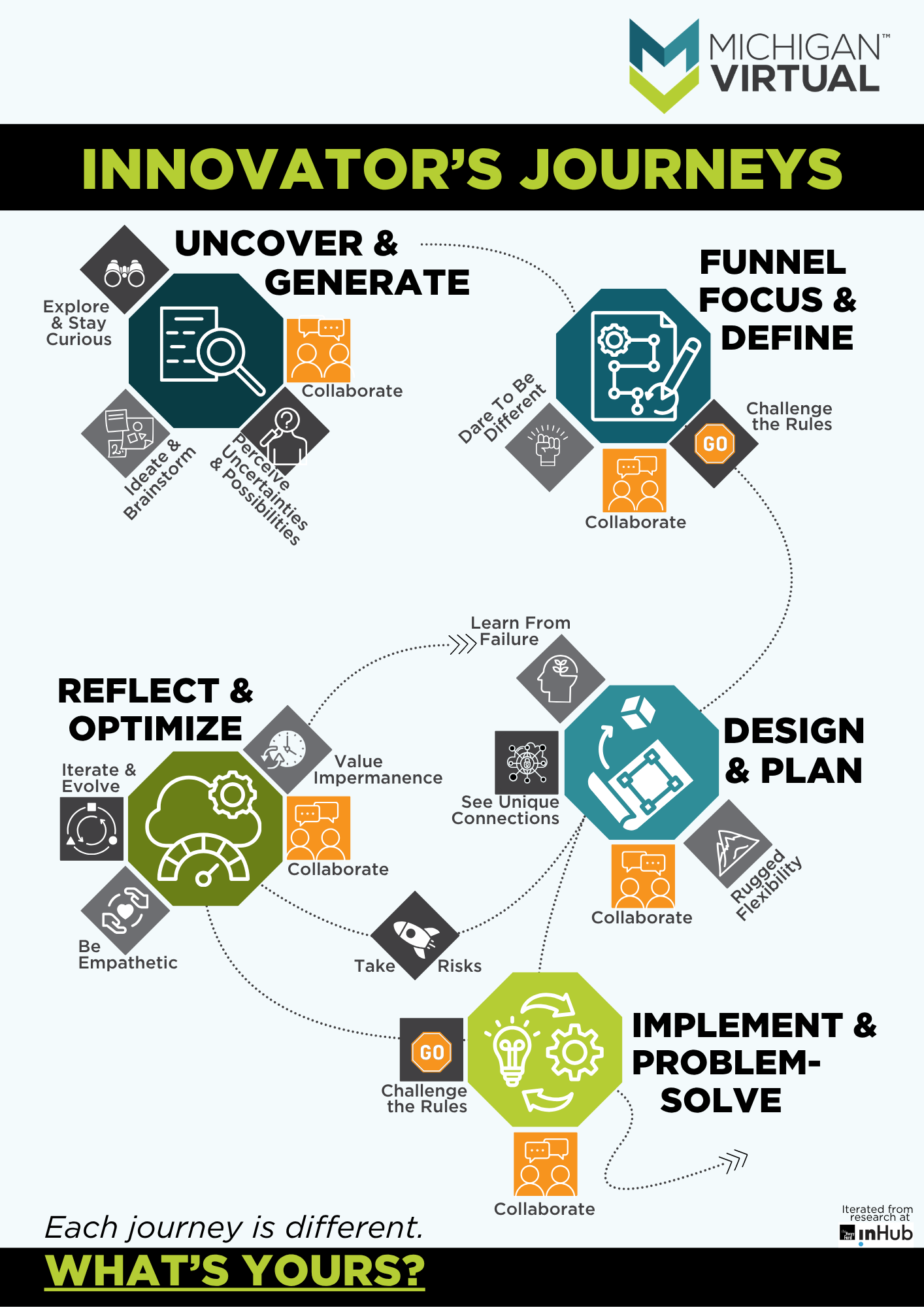
The framework names major actions of the journey, including uncover and generate, funnel focus and define, design and plan, implement and problem-solve, and reflect and optimize. Around those actions, leaders encounter habits, ways of thinking, and behaviors such as staying curious, brainstorming, collaborating, perceiving uncertainties and possibilities, daring to be different, taking risks, learning from failure, seeing unique connections, being empathetic, iterating, and valuing impermanence.
This is not an exhaustive list, and the field-tested competencies continue to evolve. Even so, simply encountering this language can be powerful. Some leaders will immediately recognize themselves in the journey, while others may find that these competencies feel new, unfamiliar, or even uncomfortable (and that is okay). That is an opportunity.
This is important to recognize because many school leaders are already engaged in innovative work but may not always have the language to describe it. They are uncovering unmet needs, challenging assumptions, designing new solutions, navigating resistance, adjusting in real time, and learning from what does and does not work.
Michigan Virtual’s Innovator’s Journeys helps leaders recognize that these are not isolated tasks. They are part of a larger, powerful process.
Just as critical, the framework makes clear that innovation is not only about producing a result. It is also about becoming the kind of leader who can guide change with clarity, courage, empathy, and adaptability.
3 Truths about Michigan Virtual's Innovator's Journeys
1. Innovation Becomes Visible and Learnable
A major strength of the framework is that it helps leaders clearly see the habits, behaviors, skills, and ways of thinking that support innovation. In schools, that is especially important because innovation can otherwise feel abstract, intimidating, or exclusive.
Leaders can become more skilled at noticing patterns, asking better questions, exploring possibilities, engaging others, refining ideas, learning from setbacks, and responding with agility. The framework provides language for those moves, making them easier to develop deliberately.
When innovation is treated as something only a few exceptional people do, many leaders quietly disengage. They assume they are not innovative, creative, or visionary enough. Michigan Virtual’s Innovator’s Journeys challenges that misconception. It suggests that innovation is not hidden within a particular personality type. It is a set of practices that can be strengthened. Innovation, then, is not limited by age, title, or other demographics. When students and educators see leaders on their own innovator’s journeys, they are more likely to join in and believe they, too, are innovators. Innovation is for all.
2. Curiosity Becomes a Serious Leadership Asset
Another strength of Michigan Virtual’s Innovator’s Journeys is its emphasis on curiosity. At a time when educational leaders are under pressure to act quickly, solve visibly, and produce results under constant scrutiny, curiosity can seem secondary. In reality, it is one of the most valuable capacities a leader can protect and cultivate.
Curiosity helps leaders slow down long enough to understand what is really happening beneath a challenge. It opens space for stronger questions before premature answers. It helps leaders perceive uncertainties and possibilities rather than reacting only to surface-level problems. It keeps exploration alive when systems are tempted to settle too quickly for the familiar.
For school and district leaders, curiosity is not a luxury. It is a strategic leadership approach. It enables leaders to move beyond compliance-minded responses and toward more thoughtful, responsive, and innovative action.
3. Human-Centered Design Stays Present Without Becoming Rigid
A third strength is that the framework reflects design-thinking principles without turning them into a script. Human beings remain at the center of the work. Empathy matters. Reflection matters. Collaboration matters. Iteration matters.
At the same time, the model does not force leaders into a narrow sequence of prescribed steps. That flexibility is especially important in education, where context, timing, relationships, history, and community needs all shape the nature of change. Michigan Virtual’s Innovator’s Journeys offers structure without rigidity. It gives leaders a way to make sense of innovation without pretending that meaningful change unfolds in straight lines.
What Michigan Virtual's Innovator's Journey Is Not
Sometimes graphic representations of ideas, like the image of the Michigan Virtual’s Innovator’s Journeys included above, lead to assumptions or misconceptions. So, it is important to address what Michigan Virtual’s Innovator’s Journeys is not.
Michigan Virtual's Innovator's Journey Is Not Linear
The visual may infer phases, but it should not be interpreted as a step-by-step roadmap. Real innovation does not unfold in a neat sequence. Leaders revisit earlier thinking, redefine the problem, gather new voices, test assumptions again, pause, adapt, and change course as they learn. Remember, work worth doing is messy! That is not a breakdown in the process. It is the process.

The Actions Are Not One-Time Events
Leaders do not uncover once, design once, collaborate once, or reflect once. These are recurring practices. A leader may brainstorm at the beginning of a process, return to brainstorming after new insight emerges, and revisit the original challenge after implementation reveals a new reality. A team may need to learn from failure more than once. A leader may return to reflection after what initially appeared to be a strong plan meets practical resistance. Each innovation, person, and context may call for some actions more so than others. The real truth is that each journey is different, and we want you to be on many of them. That is one of the clearest messages in the framework itself.
Collaboration: The Habit That Shows Up Everywhere
We may intuitively know this, but both The Henry Ford’s Model i framework and Michigan Virtual’s Innovator’s Journeys clearly identify collaboration as a habit that repeatedly surfaces in innovation work.
Collaboration appears again and again because innovation is rarely a solo act. It increases the quality of thinking, widens perspective, surfaces blind spots, and strengthens the conditions for meaningful change. In schools, especially, innovation that lives only inside one person tends to remain fragile.
Innovation grows stronger when leaders have trusted spaces to test ideas, challenge assumptions, process setbacks, and refine action with others.
This is why collaboration can be understood as one of the great “super habits” of innovation. It has an extraordinary return on investment because it multiplies learning, deepens reflection, and keeps change work connected to people rather than disconnected from them.
This is where Leadership Coaching for Innovation becomes especially powerful. It is a proven process and tool for effective collaboration anywhere in or throughout your innovator's journeys.
In Part 2 of this 3-part series, educational leaders will gain a clearer understanding of what Leadership Coaching for Innovation is, what it is not, and why it works. We will build on Michigan Virtual’s Innovator’s Journeys to explore how this specialized form of coaching helps leaders think differently, act more intentionally, and move innovation forward with greater clarity, confidence, and real outcomes.
About the Author

Dr. Tovah Sheldon
Michigan Virtual School Design Strategist
For more than 20 years, Dr. Tovah Sheldon has served education as a teacher, professor, administrator, researcher, leadership coach, and consultant across pK-12 and higher education. She has a passion to cultivate constructive relationships, bring innovation to spaces that are managing complex change, and support implementation of evidence-based practices that promote equity and opportunity for all. Her demonstrated expertise ranges from curriculum, instruction, and assessment to professional development, capacity building, strategic planning, and system’s iteration for growth and sustainability. Dr. Sheldon has also served on various boards from within her community of Jackson and across the state of Michigan. Dr. Sheldon earned her Ph.D. from Michigan State University in Curriculum, Instruction, and Teacher Education.

Michigan Virtual
For more than 27 years, Michigan Virtual has partnered with K–12 school districts across Michigan to expand learning opportunities for students and educators alike. Through our high-quality online courses, taught by Michigan-certified, highly qualified teachers, we empower students to learn anytime, anywhere. We also provide affordable, impactful professional development to help educators grow in their craft. Most recently, Michigan Virtual has been at the forefront of innovation and artificial intelligence in education, offering consultation services and professional learning to guide schools in thoughtfully integrating new technologies and learning pathways.
Related Posts

Choosing Your Next Right Move: How Metaphors Help District Leaders Build Alignment and Coherence in Their Complex Systems
Many districts are doing ambitious transformation work, yet one of the most common risks is not lack of effort. It is fragmentation. This article explores how alignment and coherence, brought to life through seven powerful metaphors, can help leaders see their systems more clearly and make better decisions about what to do next.
Beyond Resistance: Understanding & Using Change Sets to Support Transformation
Leading meaningful change requires more than the right mindset. It takes the right combination of skills, tools, coaching, and systems. Explore the Change Sets framework to uncover why transformation stalls, identify what people truly need to move forward, and lead change with greater clarity and purpose.
Portrait of a Graduate 201 Article 3
Many districts have already done the work of approving a Portrait of a Graduate, naming what they want students to know, do, and become. The harder question now is how that vision moves from approval into everyday practice.
Portrait of a Graduate 201 Article 2
Many districts have already done the work of approving a Portrait of a Graduate, naming what they want students to know, do, and become. The harder question now is how that vision moves from approval into everyday practice.
Portrait of a Graduate 201 Article 1
Many districts have already done the work of approving a Portrait of a Graduate, naming what they want students to know, do, and become. The harder question now is how that vision moves from approval into everyday practice.
Kinds of Thinking
We all have a default way of thinking and most of the time, we don’t even notice it. In a complex, fast-changing world, how we think matters just as much as what we think. Overusing one kind of thinking can quietly limit our decisions, our leadership, and our growth. Becoming more intentional about how we think is one of the most important shifts we can make.