

Leadership Coaching for Innovation Part 2

Part 2: What Leadership Coaching for Innovation Is, What It Isn't, and Why It Works
Part 2 of a 3 Part Series
By Dr. Tovah Sheldon
In Part 1 of this series, we began with Michigan Virtual's Innovator's Journeys and the larger truth that innovation is not a linear roadmap. It is a dynamic, human-centered journey shaped by curiosity, collaboration, reflection, risk-taking, learning, and adaptation. We also named one habit that appears throughout that journey: collaboration. This is where Leadership Coaching for Innovation becomes especially important.
If innovation is a journey, then Leadership Coaching for Innovation is not a side conversation happening outside the work. It is one of the most effective ways leaders make sense of the work while they are actively engaged in it. It gives educational leaders a trusting, action-oriented, and structured—though never rigid—space to reflect, clarify, challenge assumptions, and move forward with greater intention.
At every turn of the journey, leadership can feel both energizing and heavy. Leaders often carry a vision for change while navigating complexity, uncertainty, competing priorities, and the realities of implementation.
They need more than inspiration. They need a process that helps them think more clearly, lead more effectively, and advance to the next level in their work. That is exactly where and why Leadership Coaching for Innovation is foundational.
What Leadership Coaching for Innovation Is
Michigan Virtual defines Leadership Coaching for Innovation as a fluid process focused on unlocking the potential in both people and processes. Through intentional, one-on-one coaching conversations, leaders are guided to connect resources, people, and strategies in creative ways in order to generate unique solutions. These conversations spark reflection, encourage new opportunities, and build a trusting environment where risk-taking, curiosity, growth, and sustained transformation can thrive. The result is not simply adapting to change, but actively shaping it with purpose, passion, and creativity.
Just as importantly, the impact is scalable. It does not stop with one leader having one better conversation. It expands into how that leader thinks, leads, decides, and influences a broader system. In short, it builds capacity while at the same time being replicable. Leaders growing through Leadership Coaching for Innovation live it forward by also sharing the practices, ways of thinking, and resources with others, expanding both influence and impact. There is no cap on scalability.
This specialized coaching model did not emerge by accident. It reflects a thoughtful blend of research and practice, drawing on ideas from experts such as Brené Brown, Art Costa, Brad Stulberg, John Arnold, Amy Webb, Elena Aguilar, Joyce Showers, and many more. Together, these contributions help shape a model that is both grounded and distinctive.
That definition matters because it captures both the depth and the uniqueness of this work. Leadership Coaching for Innovation is not generic coaching. It is not abstract leadership support. It is a specialized form of coaching designed for leaders seeking to create meaningful change while keeping innovation and people at the center.
Within Michigan Virtual’s Innovator’s Journeys, this kind of coaching helps leaders do several things at once. It creates space for reflection in the middle of action. It supports exploratory dialogue that sparks creativity and self-awareness. It helps leaders identify strengths, constraints, and next steps. It builds internal accountability, which translates to empowerment, efficacy, and agency. It scaffolds thinking when leaders are carrying uncertainty. And it helps innovation become more specific, visible, meaningful, and actionable.
That is why Leadership Coaching for Innovation belongs throughout the journey, not only at the beginning or when someone feels stuck. Whether a leader is still uncovering possibilities, defining a direction, building a plan, navigating implementation, or reflecting on outcomes, coaching provides a replicable, intentional way to think more clearly and lead more effectively.
Why the Combination Matters: Leadership + Coaching + Innovation
Part of the power of this work lies in the fact that Leadership Coaching for Innovation is more than the sum of three appealing words. Each element matters on its own. Together, they create a powerful synergy.
Leadership is not limited to title or position. As Brené Brown has described it, “a leader is anyone responsible for finding the potential in people and processes and who has the courage to develop that potential”. That framing is especially important in education, where leadership often happens across classrooms, teams, departments, buildings, and districts. Leadership Coaching for Innovation begins with the assumption that leaders are not simply managers of systems. They are cultivators of possibility.

Coaching offers a disciplined yet flexible relational process. Coaching consists of intentional conversations that use structured but authentic dialogue to deepen self-reflection, explore ideas, and develop new perspectives and skills. It happens in a one-on-one environment where trust can be established and where risk-taking becomes possible. It takes time, but it is also far more likely to sustain shifts in mindset and behavior than isolated professional development experiences.
Innovation brings the orientation toward what is possible. Innovation is not only about introducing something new. It also includes combining what already exists in unique, unexpected, or previously untried ways to serve a purpose or solve a problem. It is about connecting ideas, tools, resources, and people in different ways. It is about seeing the bigger picture, generating opportunity, challenging assumptions, and working productively within ambiguity.
When these three elements come together, something powerful happens. Leadership Coaching for Innovation helps leaders grow not only in what they know but also in how they think, frame problems, engage others, and act to drive meaningful change. The sum is greater than the parts because leadership provides the work with moral and organizational direction, coaching provides it with structure and relational depth, and innovation provides it with energy, creativity, and forward momentum.
Why the "Just Right Fit" Coach Matters More Than Many People Realize
Michigan Virtual’s Leadership Coaching for Innovation model recognizes that coaches are not interchangeable. A person can be highly accomplished or a great leader, but maybe not a great coach for innovation. Likewise, a coach may be excellent for one leader and not the right fit for another. The work is too personal, too contextual, and too trust-dependent to assume that any pairing will automatically produce growth.
That is why the matching process matters so much in the Leadership Coaching for Innovation model. The relationship between coach and leader is intentionally incorporated into the design rather than treated as an afterthought. That “just right” fit between coach and leader cultivates trust more quickly and consistently produces real relationships that last longer than the agreed number of coaching sessions. Also, educational leaders’ challenges do not arrive on a convenient professional learning calendar.

Problems emerge in real time. Opportunities emerge in real time. Tensions, possibilities, setbacks, and decisions all happen in motion. Leadership Coaching for Innovation works, in part, because it meets leaders where they actually are, when they actually need support, with a coach who can authentically show up for them.
In short, people make change more than things, so the coach/leader relationship is deeply relevant and important to Leadership Coaching for Innovation. The “just right” fit, paired with “just in time” support, can be a game changer.
What Leadership Coaching for Innovation Is Not
To understand the value of Leadership Coaching for Innovation, it is just as important to name what it is not.
First, It Is Not Mentoring
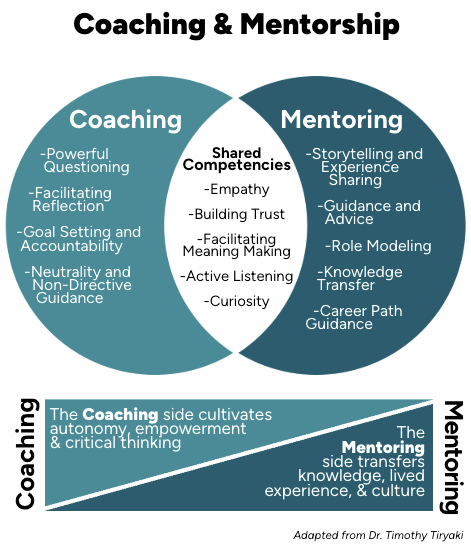
Coaching and mentoring can both be valuable, but they are not the same. According to Dr. Timothy Tiryaki, the two share some competencies and actions; however, mentoring is commonly grounded in an expert-novice dynamic and often (intentionally or unintentionally) positions individuals to have power (or not). However, coaching is grounded in empowerment. Anyone can learn from anyone, and when it comes to Leadership Coaching for Innovation, anyone can be innovative regardless of role, age, or experience. For that reason, coaching is a much better fit for the intended outcomes of this work.
This does not mean a coach can never share a story or offer guidance. It means those moves are not assumed. They are used sparingly and with permission. Leadership Coaching for Innovation recognizes the importance of permission-seeking rather than assumption-making, and that practice itself cultivates empowerment.
At its core, the model assumes that leaders already possess the raw material needed to grow innovation. The work of coaching is to help uncover it, strengthen it, and liberate the leader’s creativity and thinking. Leadership Coaching for Innovation is designed to cultivate the leader’s capacities rather than replace them or do the work for them. It develops critical, strategic, and design thinking over time and in applied, practical ways. It strengthens the leader’s ability to notice patterns, test assumptions, make better decisions, and generate more meaningful responses.
Second, Leadership Coaching for Innovation Is Not Judgment
Educational leaders are often surrounded by evaluative structures. They are observed, measured, assessed, and expected to perform. Coaching is different. In true coaching, the conversation is not built around fixing anyone, compliance, or proving one’s worth. It is built around trust.
Leaders need a space where they can speak honestly, work through uncertainty, admit what they do not yet know, and think out loud without fear of being diminished. That nonjudgmental environment is not a soft extra. It is one of the key conditions that enable growth. A coach does not judge whether an idea is innovative enough or whether an innovation will succeed. Leaders do not need more judgment. They need a thoughtful partner who can offer multiple perspectives and ask challenging questions that help them grow rather than shrink.
Third, Leadership Coaching for Innovation Is Not Linear Problem-Solving
One of the recurring misconceptions in change work is the desire to move too quickly to answers. Leaders often feel pressure to converge quickly, solve immediately, and demonstrate certainty. Yet design-thinking principles and real-world experience show that this work becomes distorted when leaders rush to “we know what works,” or have “solution-itis” simply because discomfort and ambiguity are difficult to hold.
Leadership Coaching for Innovation resists that impulse. It slows the rush to certainty long enough for more thoughtful, human-centered, and creative thinking to emerge. Some of the best ideas come from the weirdest places, or asking for just three more plausible solutions we’ve not considered yet. It does not eliminate action. It improves the quality of action. The goal is not to linger endlessly in conversation or to jump prematurely into implementation. The goal is to balance reflection, divergent thinking, and movement in a productive way.
Four Reasons Leadership Coaching for Innovation Works
1. Thinking Changes When It Is Spoken
According to an anonymous survey of leaders who completed 6 or more sessions of Leadership Coaching for Innovation, 94% found the experience highly effective. One participant, an assistant superintendent, explained, “The frank conversations revealed so much to me and clarified what I really thought I wanted out of innovating.”
When a leader talks with another person, thinking becomes visible and more real. That is not a minor insight. Many leaders carry complex thoughts privately and in unfinished form. They know they are wrestling with something important, but the thinking remains tangled until it is spoken, examined, and heard. Coaching helps bring that thinking into the open, where it can be clarified, stretched, and refined.
2. Continued Conversation Builds Internal Accountability
A one-time conversation can be useful. A trusted coaching relationship over time can be transformative. This is not the accountability of a system or an external compliance structure. Rather, when a relationship forms between a leader and a coach, leaders often develop a deeper internal sense of responsibility to show up, follow through, practice new ideas, and remain committed to their goals.
Leadership Coaching for Innovation brings internal motivations to the surface, cultivates key habits, and, over time, raises the likelihood that the change or innovation will be sustained externally as well. In other words, coaching does not simply help someone have a breakthrough moment. It helps them keep going, keep aligning, and keep becoming.
3. Multiple Perspectives Expand Thinking
Leaders are sometimes limited by what they can see from their own vantage point. Coaching creates a space where different thinking can be scaffolded, assumptions can be challenged, and new ideas can emerge through engagement with multiple perspectives. This is especially valuable in innovation work, where the breakthrough is often not a completely new invention, but a new connection among people, ideas, resources, or possibilities that had not previously been seen together.
One high school principal who participated in eight sessions of Leadership Coaching for Innovation reflected on that experience this way: “The time we spent on divergent, even wild, ideas surprised me at first because I’m usually a ‘get it done’ fast kind of leader. But it was freeing to think that way. We continue revisiting and reshaping those ideas now, and that has transformed me. Without my coach, the different connections and resources she brought to my initial ideas and her reach into other ways of thinking, I am sure I would not have landed where I did in this process.”
4. Reflection Deepens Learning
Expansive educational research, not only in coaching but across learning more broadly, shows that time spent in reflection helps deepen learning into belief, improves metacognition, and strengthens decision-making processes and habits of mind. This is one of the great underappreciated strengths of coaching.
In short, Leadership Coaching for Innovation works because it goes well beyond helping leaders solve today's problems. It effectively grows leaders to become more reflective, more self-aware, and more creative and capable in future situations. Literally growing capacity. Over time, this becomes part of the leader's way of operating and identity.
Coaching Is Foundational, Not Remedial
Leaders who want to reach the next level and cultivate innovation need Leadership Coaching for Innovation precisely because it is a specialized form of coaching. Just like professional golfers have a specialized coach for putting or their long game, so do next-level leaders benefit from coaching designed explicitly to strengthen innovation.
This idea aligns with Atul Gawande’s observation that everyone needs a coach. Even though he is known as one of the best surgeons in the world, he invites others into his world to improve his skills. Similarly, Brené Brown argues that coaching is not remedial; it is foundational. That framing matters because it moves coaching out of a deficit mindset and into a leader’s strategic advantage! Leadership Coaching for Innovation is for leaders who are serious about growth, serious about innovation and impact, and serious about doing the hard work of shaping change well.
Looking Ahead
Now that we have explored what Leadership Coaching for Innovation is, what it is not, and why it works, the next question becomes even more compelling:
What happens when leaders actually experience it?
In Part 3 of this series, we will learn from leaders across Michigan who have participated in Michigan Virtual’s Leadership Coaching for Innovation. Their stories will show what meaningful gains look like in practice, how leaders have grown to the next level, and how this specialized form of coaching has helped them innovate in ways that are real, strategic, and deeply human-centered.
About the Author

Dr. Tovah Sheldon
Michigan Virtual School Design Strategist
For more than 20 years, Dr. Tovah Sheldon has served education as a teacher, professor, administrator, researcher, leadership coach, and consultant across pK-12 and higher education. She has a passion to cultivate constructive relationships, bring innovation to spaces that are managing complex change, and support implementation of evidence-based practices that promote equity and opportunity for all. Her demonstrated expertise ranges from curriculum, instruction, and assessment to professional development, capacity building, strategic planning, and system’s iteration for growth and sustainability. Dr. Sheldon has also served on various boards from within her community of Jackson and across the state of Michigan. Dr. Sheldon earned her Ph.D. from Michigan State University in Curriculum, Instruction, and Teacher Education.

Michigan Virtual
For more than 27 years, Michigan Virtual has partnered with K–12 school districts across Michigan to expand learning opportunities for students and educators alike. Through our high-quality online courses, taught by Michigan-certified, highly qualified teachers, we empower students to learn anytime, anywhere. We also provide affordable, impactful professional development to help educators grow in their craft. Most recently, Michigan Virtual has been at the forefront of innovation and artificial intelligence in education, offering consultation services and professional learning to guide schools in thoughtfully integrating new technologies and learning pathways.
Related Posts

Choosing Your Next Right Move: How Metaphors Help District Leaders Build Alignment and Coherence in Their Complex Systems
Many districts are doing ambitious transformation work, yet one of the most common risks is not lack of effort. It is fragmentation. This article explores how alignment and coherence, brought to life through seven powerful metaphors, can help leaders see their systems more clearly and make better decisions about what to do next.
Beyond Resistance: Understanding & Using Change Sets to Support Transformation
Leading meaningful change requires more than the right mindset. It takes the right combination of skills, tools, coaching, and systems. Explore the Change Sets framework to uncover why transformation stalls, identify what people truly need to move forward, and lead change with greater clarity and purpose.
Portrait of a Graduate 201 Article 3
Many districts have already done the work of approving a Portrait of a Graduate, naming what they want students to know, do, and become. The harder question now is how that vision moves from approval into everyday practice.
Portrait of a Graduate 201 Article 2
Many districts have already done the work of approving a Portrait of a Graduate, naming what they want students to know, do, and become. The harder question now is how that vision moves from approval into everyday practice.
Portrait of a Graduate 201 Article 1
Many districts have already done the work of approving a Portrait of a Graduate, naming what they want students to know, do, and become. The harder question now is how that vision moves from approval into everyday practice.
Kinds of Thinking
We all have a default way of thinking and most of the time, we don’t even notice it. In a complex, fast-changing world, how we think matters just as much as what we think. Overusing one kind of thinking can quietly limit our decisions, our leadership, and our growth. Becoming more intentional about how we think is one of the most important shifts we can make.