
Online Student Success Triangle — Students, Mentors, & Parents

So far in our Success in Online Learning blog series, we have looked at how to plan and set up online students for success, as well as program and course elements designed to support online students.
We’ve discussed how mentors serve as a critical in-person support at school for the online learner but haven’t yet discussed at length how parental support, in conjunction with mentor support, operates to better serve students.
The role of the parent in online learning
Parental engagement and support are critically important to student success in any learning environment, including online learning.
While the mentor offers face-to-face support in the school environment, the parent offers support in the home environment.
Parental support is critical to student success, regardless of course format.
However, in the case of an online course, students may require extra parental support outside of school in order to:
Access and navigate technology
Understand course expectations and requirements, and
Complete course work.
The relationship between mentors & parents
If you conceptualize the relationship between students, mentors, and parents as a triangle with students at the top, the line connecting mentors and parents becomes important as well.
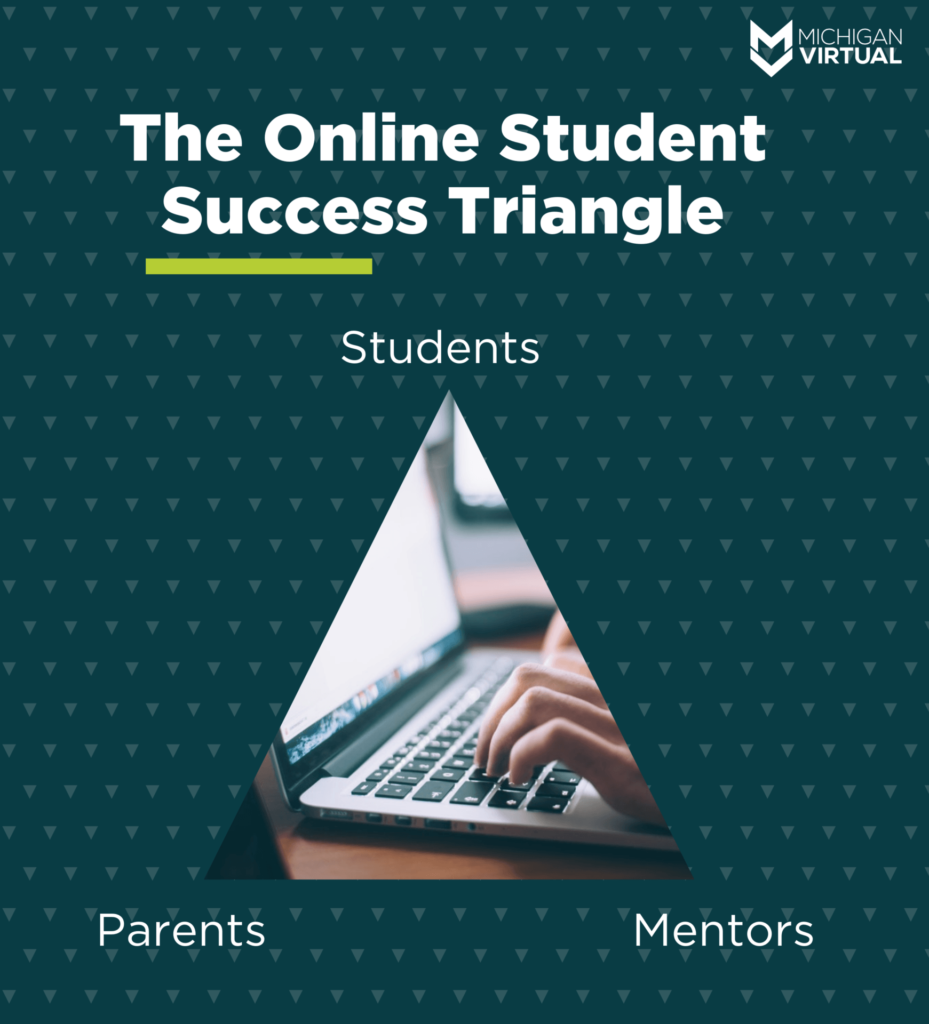
This relationship starts even before the student enrolls in the online course.
Parents and mentors need to have an understanding of:
Why an online course was selected for the student
If the student is ready for such a course, and
How the course will impact the students academic trajectory.
It is common for either the school or parent to select an online course for the student; however, both need to be informed in order to best support the student.
Once enrolled, parents and mentors both need to have a solid understanding of the online course including but not limited to:
Access - How a student logs into an course and views content
Expectations - How often a student is expected to engage in the course and for what duration
Progression - How a student moves through a course and at what pace
Help resources - Where a student messages teachers and accesses help resources.
Both parents and mentors need to present a unified front to students regarding the amount of time and quality of work that is expected of students in the online course.
Students as active participants in this relationship
Another important element of the success triangle is the student taking an active role in the relationship between the student and mentor and student and parent.
When we say “active role,” what we mean is that the student communicates openly and honestly with both the mentor and parent about the online course and any challenges they may be facing. This also means seeking help when needed from the mentor or parent and possibly the online instructor.
Many online courses have mentor or parent dashboards, but often times issues with progress are not flagged until it is too late.
That’s why students need to be active and vocal participants in their online learning just as they are expected to be in their face-to-face classrooms.
Parental support is beneficial to student success in any learning context. In the online learning context, the addition of mentor support creates an optimal support structure for online learners.
Success in Online Learning blog series
In our Success in Online Learning blog series, we discuss all things K-12 online learning in Michigan and across the nation. Our hope with this series is to provide a primer on K-12 online learning, cover established and emerging topics, and provide relevant research and resources. Stay up to date on future blogs in this series by signing up for email notifications!
About the authors
Kristen DeBruler
Dr. Kristen DeBruler received her doctorate in Educational Psychology and Educational Technology from Michigan State University. She taught in the Master of Arts in Educational Technology program at Michigan State University for three years. Her work focuses on K-12 online learning policy in Michigan and nation wide as well as understanding online learning best practices.
Christopher Harrington
Dr. Christopher Harrington has served public education as a teacher, an administrator, a researcher, and a consultant for more than 25 years and has experience assisting dozens of school districts across the nation in the design and implementation of blended, online, and personalized learning programs. He has worked on local, regional, and national committees with iNACOL and various other education-based organizations aimed at transforming education through the use of technology.
Michigan Virtual Learning Research Institute
Coming Soon
Related Posts

Just the essentials: What mentors of online students want and need from professional learning
Research indicates that online learners perform better when they have strong onsite mentor support. But mentors need support, too. Drawing on survey responses, this blog examines mentors’ current practices, key challenges, and unmet needs—and what those insights mean for designing more effective professional learning.

Have You Considered AI in Your Classroom? A Khanmigo Pilot Story
In a two-phase pilot across Michigan schools, educators used Khanmigo, an AI-powered tutor and teaching assistant, to explore how AI might support teaching and learning. Their reflections surfaced both opportunities and challenges. The big takeaway? AI has potential, but only with intentional support.

Out of Order, Still Out of Reach: Variations in Pacing among World Language Students
Cuccolo & Green’s (2025) report highlighted the relationship between students’ assignment submission patterns and final course scores. Given that pacing has important implications for student performance, knowing what assignment submission patterns look like across schools with varying demographics could help prompt early identification and intervention. As such, this blog explores students’ assignment submission patterns based on school-level demographic information.

From Curiosity to Career: Exploring Possibilities with VR
Explore how immersive VR simulations helped students step into real-world roles: from EMTs to chefs, all without leaving the classroom.

Out of Order, Still Out of Reach: An Interview with a Researcher
In this blog, MVLRI researchers synthesize the key findings from two research studies about student assignment submission patterns in Michigan Virtual online courses.
