

Using Roadmaps to create deeply digital lessons for students
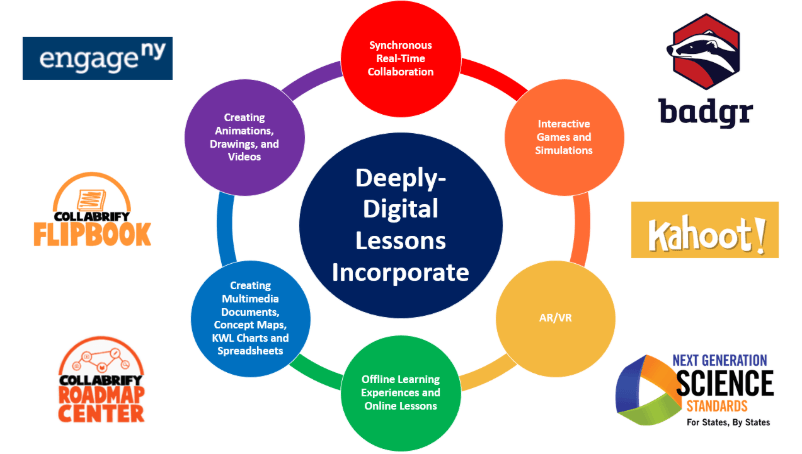
Source: University of Michigan Center for Digital Curricula
We know teachers have so much on their plates every single day.
When it comes to crafting a deeply digital curriculum — one that encourages real-time, synchronous, collaborative, interactive, and experiential learning — teachers often simply do not have extra time to develop their own deeply digital resources while at the same time managing everything else that happens in a school day.
That’s why I’m such an advocate of open educational resources (OER), which I’ve been using for the past 3 years in my social studies classrooms and promoting for wider use in my district and across the state.
Because these resources are freely available and produced by other educators, I can spend less time developing my own deeply digital resources from scratch and instead devote my time to incorporating quality resources from other educators into my curriculum.
Collabrify is a suite of tools created by the University of Michigan’s Center for Digital Curricula that supports 1:1 classrooms and collaborative learning. The Collabrify Roadmap platform, in particular, allows teachers to create, tweak, or differentiate deeply digital lessons using OERs. These lessons take the form of a “roadmap” that students can follow in their web browsers and engage with resources at their own pace. Lessons are distributed through the Dashboard where both the student and teacher can access and interact with the lesson.https://youtu.be/fyl7jK0sMpcOther tools in the suite include Collabrify Chart, Collabrify KWL, Collabrify Writer, Collabrify Flipbook, and Collabrify Map. All of these programs can be used by students on their own devices to digitally co-create charts, KWLs, multimedia documents, flipbooks, and concept maps. These collaborative documents can then be incorporated into a larger, multi-step lesson Roadmap that teachers can share with their students.
The value of OERs like Roadmaps is how they are used. When I was introduced to the Collabrify platform, I knew instantly it was what our state needed to bring quality OERs to teachers and their students in a simple way.
I have piloted Roadmaps within instructional units, as test preparation, and for student creation in my 5th grade Social Studies and ELA courses. Teachers can access and use completed roadmaps from the GoOpen Site, or they have the option to create their own.
Roadmaps are very helpful for all learners to follow and can be distributed within small groups or individuals. It simplifies the 1:1 classroom environment and truly promotes individualized learning at its best!
While using Roadmaps, students take greater ownership of their own personalized learning.
My students are always excited to receive a new “map,” and they even enjoy creating their own. Because this tool is perfect for all instructional levels and subjects, the high-achievers have the ability to “go beyond” in the lesson, and the students who struggle can be accommodated across the levels/curriculum easily.
Teachers can monitor where the students are with a quick click in the “monitoring” piece of the Roadmap toolbar. This allows you to see and assess student progress on any lesson or assignment which is an important feature when students could be at various places within the assignment.
I also find that Roadmaps can create great toolkits for review of any subject matter, especially when it is time to prepare for M-Step in the Spring.
Ultimately, everyone benefits from OERs like those in the Collabrify suite.
Students will always benefit when a teacher can bring meaningful curricula to them in an organized, simplified fashion, and teachers will always benefit when quality curricula is shared. The uses for Roadmaps are endless, and the value of this tool is just beginning to show in classrooms the more it is promoted and supported. As we begin to shift to more 1:1 classroom environments, I am confident that any teacher who chooses to use Roadmaps will see the difference in their planning and in their classroom.
For more information on this resource, visit the Center for Digital Curricula and Collabrify's Roadmap System.
Denise Gallemore
Denise Gallemore is a 30+ year veteran K-6 classroom, Distinguished Evaluated Educator, & Co-Author of the 5th Grade State of Michigan Social Studies Open Education Textbook. She has been an integral part of the OER "Movement" at the District, State, and National levels. Denise serves on the MDE GoOpen Strategy Team (since 2016) as part of the Content Curation/Vetting Committee. She has traveled across Michigan and the US to train & consult other educators on how to use & implement OER's in the classroom. She has presented at MACUL, ISTE, and many other state & national venues. Furthermore, Denise feels strongly that the Collabrify Roadmap Platform is a powerful "key" for the use & implementation of OERs.
Related Posts
From Simple Squares to Sweaters: How One Teacher Uses Crochet to Build Confidence
When Erica Gorzen’s students pick up a crochet hook, they choose their own path. Some make simple squares. Others create sweaters and stuffed toys. As the 2026-2027 Regional Teacher of the Year, this Portland High School art teacher shares how choice-based lessons help her students build confidence, independence, and a love of learning that lasts well beyond the classroom.
Build Trust, Boost Autonomy, & Design Smarter Check-Ins With Students
Strong student relationships don't happen by chance. They happen by design. Discover how structured check-ins can build trust, strengthen student autonomy, and help you create more student-centered learning experiences. Plus, access a free template or earn a SCECH while creating a check-in routine for your classroom.
Revisiting the 5:1 Ratio: Reflecting on a "Magic" Ratio Just Too Tidy to be True
A popular idea in education holds that teachers should aim for five positive interactions for every one corrective one. It spread quickly, cited widely, and seemed to just make sense. There was only one problem: the research behind it was never really about teaching at all.
Everyone Has a Story
Learn how one Michigan educator helps students connect with each other and with the power of storytelling. Back when I began teaching...
The Power of the 5:1 Ratio: How Fostering Positive Interactions Can Transform Student Learning
The 5:1 ratio has completely changed my thinking about interactions in the classroom. It all started with a question about grading. After all, part of our jobs as teachers is to provide corrective feedback to help students grow. The 5:1 ratio helps to ensure that students can receive this feedback effectively. More importantly, however, it can help us be intentional about creating a classroom environment that centers our humanity.

Time for Teachers: Self-Assessment with Community Support as Individual Solutions
Educators often cite a lack of time as one of their most significant stressors. How can we help teachers find the balance necessary to feel satisfied in their jobs and meet their social and emotional needs? This third post in the Time for Teachers blog series will discuss the importance of a self-assessment in addressing individual problems and solutions teachers face. This is not to say the onus of addressing challenges should fall squarely on the shoulders of individual teachers. Teachers need a community of practice and support to help them identify problems they might face individually that could benefit from solutions that come from consulting with colleagues.