
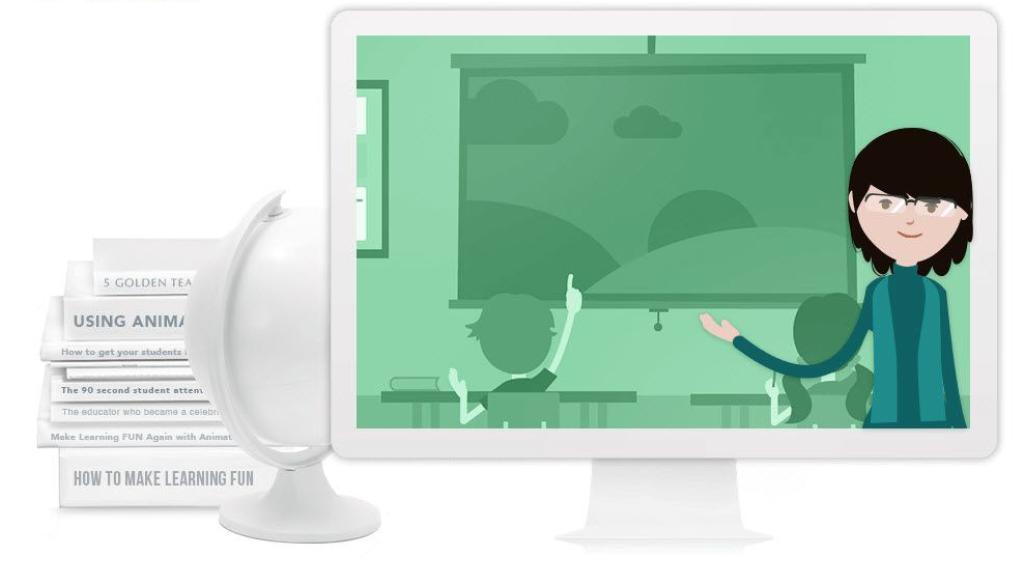
Using PowToon to explain challenging concepts to students

Using PowToon to explain challenging concepts to students
By Jaclyn Hartman
As an online teacher, one of the best ways I have found to reach my students is to help them relate content to their "real lives." I have found that once students have an opportunity to relate to the content or observe a concept in real life, they are more likely to explore it further.
But one of my challenges is this:
I teach in an asynchronous program, so my students are not necessarily online at the same time as I am. One tech tool that has helped me to bridge this divide is PowToon, the video-making software that allows teachers to create engaging, animated clips to help explain challenging content to students.I primarily teach high school chemistry and physics, but also astronomy and forensic science. Two concepts that my students commonly misunderstand are free-fall and the velocity and accelerations at different points in the tossing of an object. I wanted students to understand this important foundation in kinematics and be able to see what was happening while also being engaged.In a face-to-face classroom, I would explain this concept through a conversation and tossing a ball. We might add diagrams on the board.
But here’s the catch: I don’t teach in a face-to-face classroom.
In the online classroom, I wanted to get the same information to students in a way that was conversational and interesting. I chose the tool PowToon to create my own animated video to demonstrate these concepts for students.https://youtu.be/i_sbjQDRuj8 This is one of the top-viewed videos by students in my Physics A course because it has a fun look that encourages students to click. I have received messages from students on how much they like the video and how it has really helped them understand the concepts.
Another tip:
This tool can also be used by students to create their own videos to demonstrate understanding of a topic. They can create how-to videos, short stories, etc. Using PowToon is a great way to allow students to demonstrate understanding in a creative and fun way.
The best part? It’s working.
Overall, my classroom data shows students have increased scores on multiple choice questions covering this topic. Students are able to incorporate this understanding into other assignments and compare acceleration when there is and is not motion. It is helping them make connections across the course.

Jaclyn Tyler
Jaclyn has a passion for science, which lead her to study chemistry and physics at Marquette University for a bachelor's degree. She also has a master's degree in education from Cornerstone University. On top of teaching for Michigan Virtual, Jaclyn has been a face-to-face teacher since 2005 in Forest Hills Public Schools. When not teaching, you can find Jaclyn teaching fitness classes, spending time with her family and their bulldogs.
Related Posts

Everyone Has a Story
Learn how one Michigan educator helps students connect with each other and with the power of storytelling. Back when I began teaching...
The Power of the 5:1 Ratio: How Fostering Positive Interactions Can Transform Student Learning
The 5:1 ratio has completely changed my thinking about interactions in the classroom. It all started with a question about grading. After all, part of our jobs as teachers is to provide corrective feedback to help students grow. The 5:1 ratio helps to ensure that students can receive this feedback effectively. More importantly, however, it can help us be intentional about creating a classroom environment that centers our humanity.

Time for Teachers: Self-Assessment with Community Support as Individual Solutions
Educators often cite a lack of time as one of their most significant stressors. How can we help teachers find the balance necessary to feel satisfied in their jobs and meet their social and emotional needs? This third post in the Time for Teachers blog series will discuss the importance of a self-assessment in addressing individual problems and solutions teachers face. This is not to say the onus of addressing challenges should fall squarely on the shoulders of individual teachers. Teachers need a community of practice and support to help them identify problems they might face individually that could benefit from solutions that come from consulting with colleagues.

Time for Teachers: Agile Meetings and Short Pulse Surveys as Systemic Solutions
Educators often cite a lack of time as one of their most significant stressors. How can we help teachers find the balance necessary to feel satisfied in their jobs and meet their social and emotional needs? This second post in the Time for Teachers blog series will discuss two possible solutions that can help all educators save time while addressing needs to serve students and communities: agile meetings and short pulse surveys.

Tips and Tricks for Communicating with Parents and Students
During this time of remote learning, what are some best practices in the ways you communicate with your students and their parents? In this webinar, we’ll explore examples and tips for communication, specific tools and resources to aid this process, and lessons learned from applying these practices.

You Can Do This! Transitioning to Remote Teaching & Learning
Are you feeling overwhelmed about transitioning your classroom into a remote learning environment? In this webinar, we share simple strategies for getting started, communicating with students and parents, finding and delivering content, building relationships, and designing assessments. You can do this!