
Comparing virtual schools in Michigan to national trends identified in NEPC’s recent national report
On March 10, the National Education Policy Center (NEPC), released its third annual report on virtual schools in the U.S. In this report, entitled Virtual Schools in the U.S. 2015, the authors tackle subjects such as key policy issues in virtual schools, existing research to guide policy, and statistics on the number of virtual schools, demographics about who attends them, and comparison measures against national statistics for students attending traditional brick and mortar schools.In summarizing key points about full-time virtual schools, authors Gary Miron and Charisse Gulosino state that virtual schools served a higher proportion of girls than boys and “[r]elative to national public school enrollment, virtual schools had substantially fewer minority students, fewer low-income students, fewer students with disabilities, and fewer students classified as English language learners.”Given that these findings were based on national data, the research team at MVLRI was interested in how those general findings aligned with virtual schools within the state of Michigan. To find out, MVLRI used the MI School Data website (https://mischooldata.org) to look up these same metrics using information available to the public. MVLRI looked up the data for seven schools identified by the state of Michigan as cyber schools. These seven schools were: [table id=4 /]*Mosaica Online Academy of Michigan has since changed its name to Mackinac Preparatory AcademyNational Finding #1 – Virtual schools were skewed in favor of girls.Michigan Finding #1 – Based on data for the 2013-14 school year, five of the seven virtual schools had higher proportions of female students than the statewide average. See Figure 1.
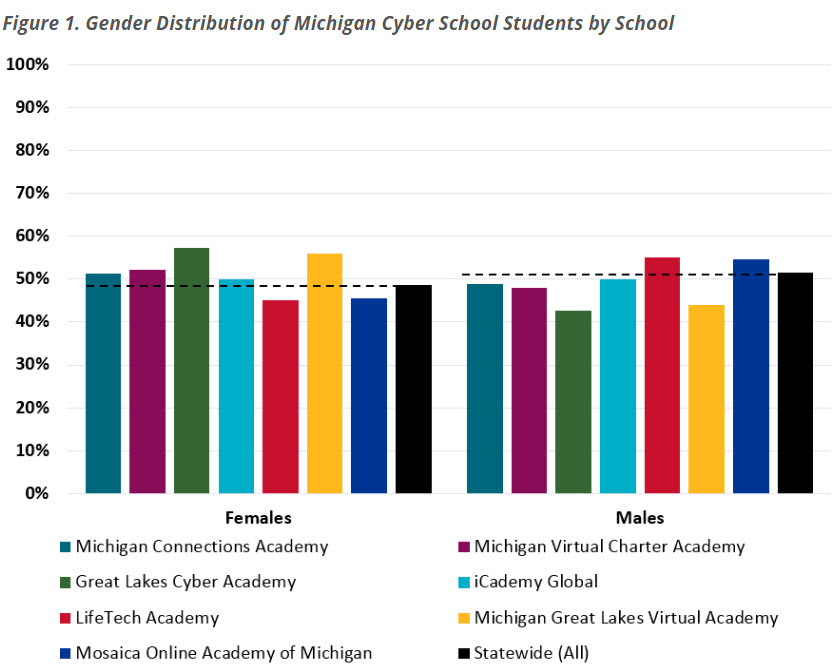
National Finding #2 – Virtual schools had substantially fewer minority students.Michigan Finding #2 – Based on data for the 2013-14 school year, five of the seven virtual schools had fewer minority students than the statewide average. See Figure 2.
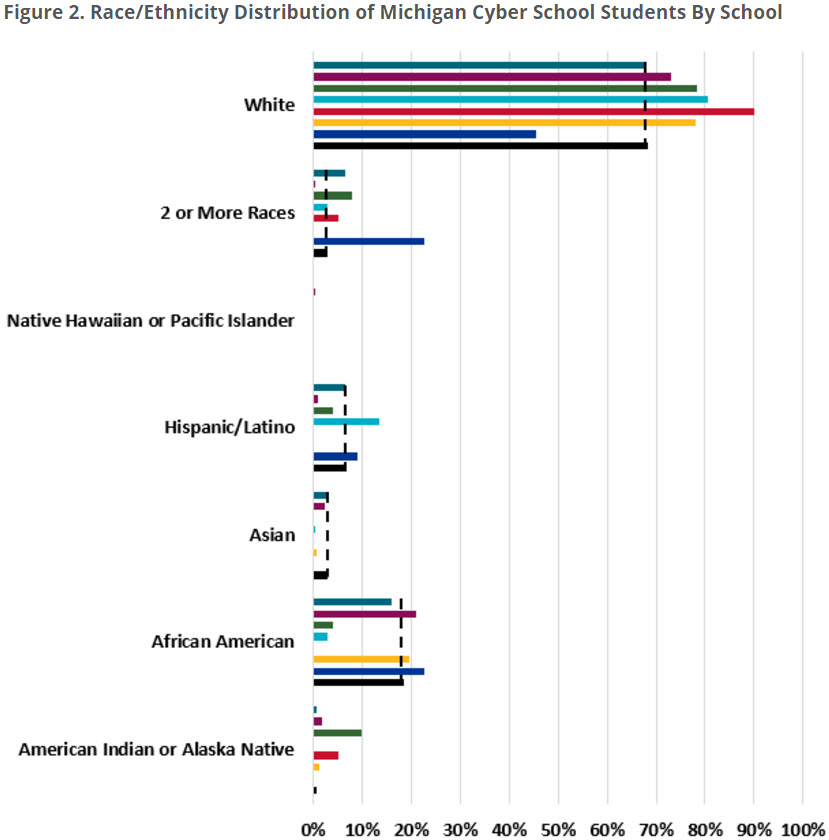
National Finding #3 – Virtual schools had fewer low-income students.Michigan Finding #3 – Based on data for the 2013-14 school year, five of the seven virtual schools had higher proportions of low-income students than the statewide average. See Figure 3.
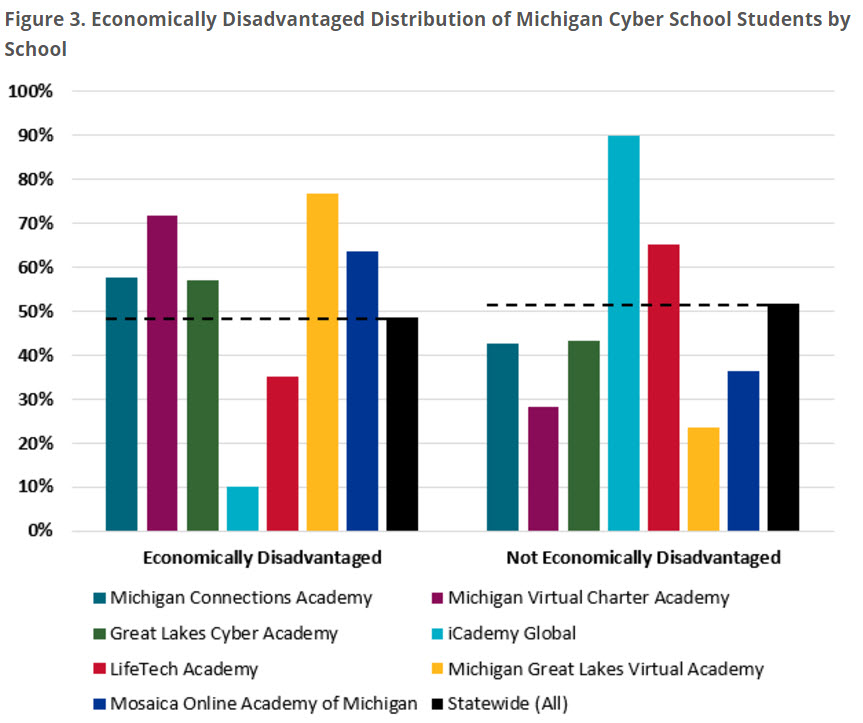
National Finding #4 – Virtual schools had fewer students with disabilities.Michigan Finding #4 – Based on data for the 2013-14 school year, four of the seven virtual schools had higher proportions of students with disabilities than the statewide average. See Figure 4.
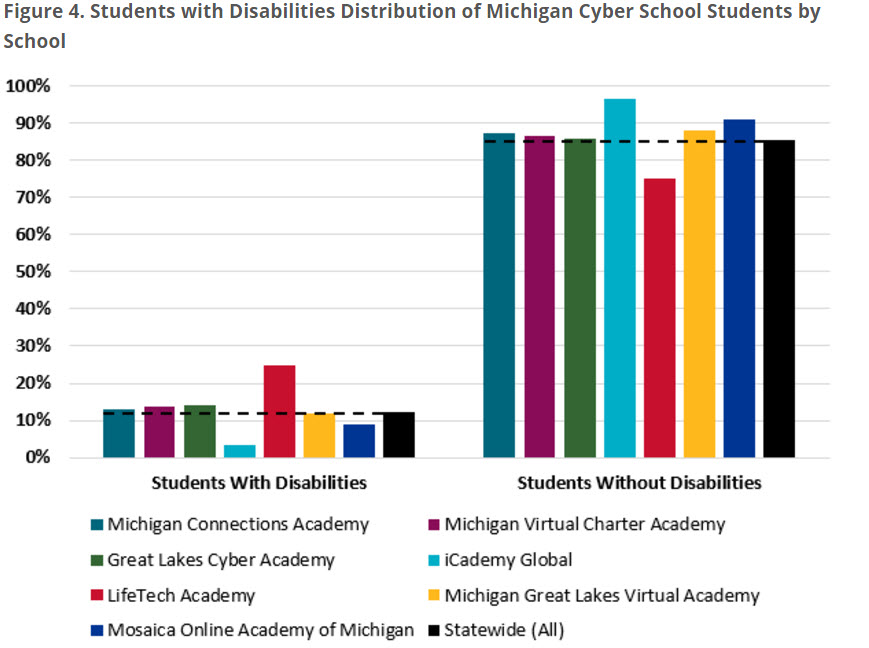
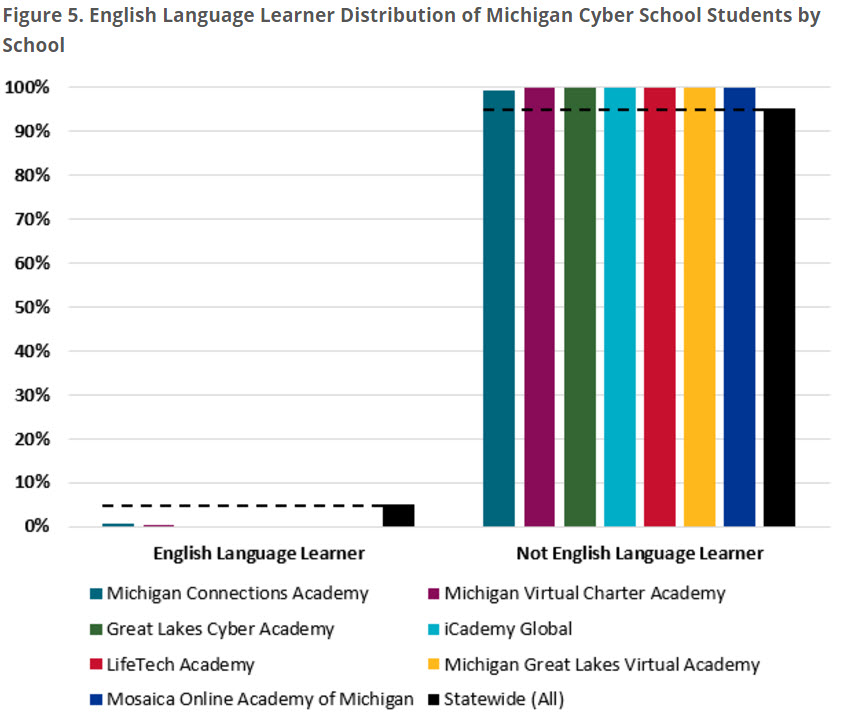
National Finding #5 – Virtual schools had fewer students classified as English Language Learners.Michigan Finding #5 – Based on data for the 2013-14 school year, all seven virtual schools had fewer students classified as English Language Learners than the statewide average. See Figure 5.
Conclusion
In conclusion, the national trends that more females are being served by virtual schools, fewer minority students are enrolled in virtual schools, and virtual school students are less likely to be classified as English Language Learners appear to be true for virtual schools in Michigan for the 2013-2014 school year. In contrast to the national trend, Michigan appears to have virtual schools serving higher percentages of low-income students than the statewide average and four of the seven virtual schools have higher rates of students with disabilities compared to the state average. As this quick analysis demonstrates, it is often important to understand both the national trends as well as state-level trends as the two may not necessarily be the same.
Michigan Virtual Learning Research Institute
Coming Soon
Related Posts

Out of Order, Still Out of Reach: Variations in Pacing among World Language Students
Cuccolo & Green’s (2025) report highlighted the relationship between students’ assignment submission patterns and final course scores. Given that pacing has important implications for student performance, knowing what assignment submission patterns look like across schools with varying demographics could help prompt early identification and intervention. As such, this blog explores students’ assignment submission patterns based on school-level demographic information.

From Curiosity to Career: Exploring Possibilities with VR
Explore how immersive VR simulations helped students step into real-world roles: from EMTs to chefs, all without leaving the classroom.

Out of Order, Still Out of Reach: An Interview with a Researcher
In this blog, MVLRI researchers synthesize the key findings from two research studies about student assignment submission patterns in Michigan Virtual online courses.

Understanding Teacher-Student Communication in Online Courses: An Interview with a Researcher
In this interview, MVLRI researchers discuss key findings from a report highlighting how personalized, consistent, and timely communication in online courses can help students feel more connected to their online teachers and may also impact their success in the course. This blog also explores practical strategies for communicating effectively and building relationships with online students.

Understanding What Motivates High School Students to Pursue Computer Science

Evaluating and Maximizing Professional Learning: An Interview with a Researcher
This blog digs into the key findings from two MVLRI research studies exploring educator engagement with professional learning (PL), their beliefs about implementing what they’ve learned, and insights into continuing to tailor PL to meet educators’ needs.