
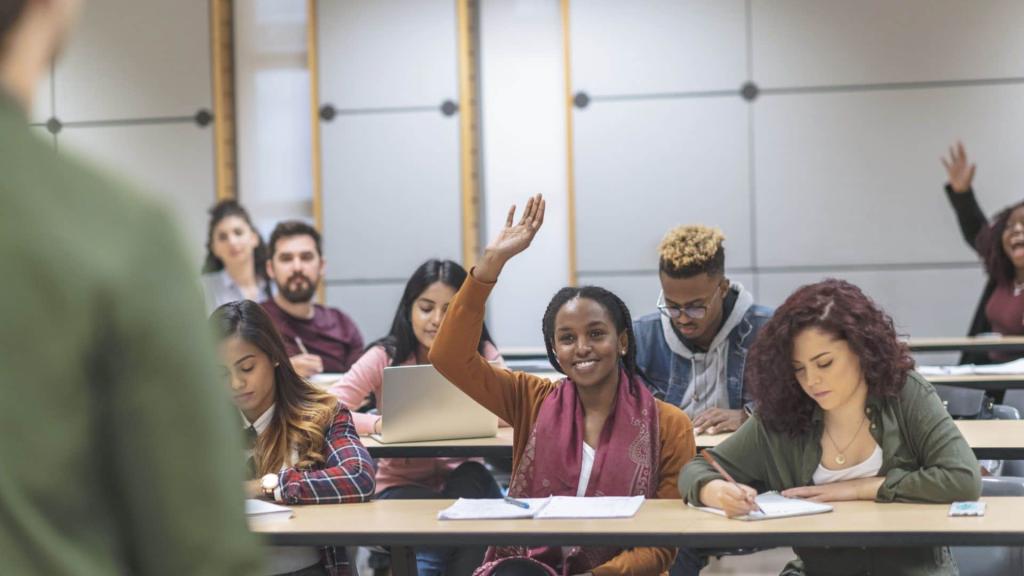
4 differences between traditional teaching methods and competency-based education

What is competency-based education, and why are so many schools making the switch?
Competency-Based Education (CBE) is a student-centered method that allows students to work asynchronously on their skills and show mastery in many different ways. This method differs from simply passing a summative assessment or exam.
In a competency-based classroom, students have choices and control regarding what and how they learn. Most importantly, they have flexibility as to how they show what they have learned and mastered.
CBE is a flip-flop of the teacher-centered methods that have been used for years and still are frequently used all over the world. In this mode of instruction, the teacher dictates what and how the students learn, as well as curates any content that is presented to them with very little student input.
Many schools have been transitioning away from teacher-centered instruction to student-centered methods, like CBE, to allow students to learn at a pace and with the materials that suit them best.
When learning is competency-based, students often learn by “doing,” which fosters creativity and curiosity because students are encouraged to show what they have learned in a variety of ways.
Traditional methods are also not akin to how the “real world” works. Once students become adults, the working world expects products to be made, problems to be solved, and skills to be used.
As adults, they will be expected to apply what they learn successfully, which is similar to what is expected in a competency-based classroom.
For these reasons, student-centered learning is here to stay.
“This is different…I like the way it used to be!”
Some students have difficulty adjusting to competency-based learning, especially if they have spent a considerable amount of time learning in a teacher-centered environment.
A competency-based classroom may also mean students are learning fully online or have large online components, resulting in a drastic departure from the norm for many students.
Here are some common differences between a more traditional learning environment and one that is competency-based:
1. Less social interaction
Because CBE is often asynchronous or has asynchronous components, students may interact with their peers and teachers less than normal.
While lacking a physical space can take some getting used to, it can also allow students who are uncomfortable speaking in front of an entire class to still communicate with others effectively without the pressure and anxiety they may normally feel.
In addition, less face-to-face time also means that students are less likely to be distracted by one another and be more efficient with their time spent learning.
2. Time management
Each student is unique, moves at a different pace, and learns best in a variety of ways.
This means that students in CBE environments will master things at different paces, and students will need to acquire self-discipline and time management skills in order to be successful.
Luckily, these skills are highly desired in the “real world” and valued by employers, so practicing these skills will be fruitful.
3. Overwhelmed by choice
Students are often used to very rigid and structured pacing with completion criteria for getting high marks in their classes.
CBE is highly flexible in regards to time, content, and methods of displaying mastery.
Students can become overwhelmed with the responsibility of learning that is now thrust upon them.
Ultimately, however, this will allow students to carve out their own processes for how to solve problems, honing their skills with a personal spin.
4. Less explicit instruction
In CBE courses, teachers are a resource for students, not the keeper of knowledge or master of the class.
This means that rather than dispersing all of their knowledge and expecting students to absorb it, teachers offer guidance and assistance while students investigate problems and develop their skills.
Teachers function more like a facilitator of learning, and the students are the key component of which everything revolves around.
This can be a struggle for students who are uncomfortable with approaching their instructors when in need of assistance.
It does, however, remove the barrier of social anxiety that many students face when asking for help in a traditional setting where their peers may be made aware of their struggles; it can be a great opportunity for students to learn to ask questions without any outside pressure.
How do I make sure that I succeed?
In order to succeed in a CBE environment, consider the following:
Use time management strategies
Just because the due date for a mastery project or assignment is the last day of the class does not mean that students can delay learning until the last two weeks. Students must regularly set aside time to work on assignments, watch videos and read, or discuss struggles with other students and the instructor.
Review instructions and rubrics
Rubrics are created by instructors in order to define the expectations for their courses. These documents will outline how to get display mastery and complete assignments for satisfactory marks in the course. Do not ignore them when completing assignments.
Practice makes perfect
In CBE, as in the real world when learning a skill, it often takes multiple attempts until a student gets it right. This means that revisions are a critical and normal component of learning; students will work until they have a product that shows they have mastered the skill or content.
Become comfortable with asking for help
Instructors are an invaluable resource and are dedicated to helping students succeed. However, they can’t help anyone if they don’t know that they are struggling. Students should not be afraid to ask for help, such as if they don’t know what step to take next.
Become familiar with the online components
Because CBE courses are largely asynchronous, most of the course materials may be online. Students should familiarize themselves with the platform that their course is on, locate important materials and pages, and understand how to navigate through all the content. This will allow them to quickly find resources, submit assignments, or connect with instructors.
Resources and Tools for Students
The number one resource in any course should be the instructor.
They can provide students with invaluable feedback and help point them in the right direction. However, sometimes even instructors may not be aware of some resources that exist to help students complete assignments and master skills. Here are a few general resources:
33 Free Tools for Learning (Includes apps, programs, and websites)
Portfolium: (An online portfolio to keep track of assignments and projects, great for college applications/résumés)
Final Thoughts
While CBE certainly has some differences from the traditional methods of teaching and learning, its impact on helping students gain valuable skills and knowledge cannot be contested.
As our technological society advances, so must our teaching and learning so that the students of tomorrow can be successful.
Although adjusting can be a struggle, nothing worthwhile is ever easy!
For more information on CBE check out our previous blogs about classroom challenges and CBE and how CBE is designed for student success.
Competency-Based Education blog series
In our CBE blog series, we explore CBE in terms of tools for parents, teachers, and students. Next month’s topic will be student resources for success in math CBE courses.
Stay up to date on future blogs in this series by signing up for email notifications!

Nikolas McGehee
Senior Research & Innovation Specialist
Dr. Nikolas McGehee has a passion for improving education through research and innovation. He has expertise in advanced research methodologies and analytics as well as STEM education practices, trends, and issues. He has two children, Jace and Ellie, and dreams of making large-scale changes in education so that they can learn and excel in a world where students achieve their dreams and goals through exceptional educational opportunities.
Related Posts

Understanding How Students and Teachers Think About Responsible AI Use: An Interview with a Researcher
Students and teachers generally understand the risks of AI misuse, but they are less clear about what responsible AI-supported learning should look like in practice. This interview highlights findings from a Michigan Virtual study showing that students need clearer examples, consistent expectations, and practical guidance for using AI transparently and appropriately in schoolwork.

What Happens to Students' Online Course Scores After the Course Ends?
The moment an online course ends, a new question begins: how will that score be recorded locally? Drawing on a 2025 brief and a small follow-up survey, this blog post outlines three common approaches districts use to interpret and record students’ online course scores and why the differences can matter for students.
Out of Order, Still Out of Reach: Variations in Pacing among World Language Students
Cuccolo & Green’s (2025) report highlighted the relationship between students’ assignment submission patterns and final course scores. Given that pacing has important implications for student performance, knowing what assignment submission patterns look like across schools with varying demographics could help prompt early identification and intervention. As such, this blog explores students’ assignment submission patterns based on school-level demographic information.

From Curiosity to Career: Exploring Possibilities with VR
Explore how immersive VR simulations helped students step into real-world roles: from EMTs to chefs, all without leaving the classroom.

Out of Order, Still Out of Reach: An Interview with a Researcher
In this blog, MVLRI researchers synthesize the key findings from two research studies about student assignment submission patterns in Michigan Virtual online courses.
Understanding Teacher-Student Communication in Online Courses: An Interview with a Researcher
In this interview, MVLRI researchers discuss key findings from a report highlighting how personalized, consistent, and timely communication in online courses can help students feel more connected to their online teachers and may also impact their success in the course. This blog also explores practical strategies for communicating effectively and building relationships with online students.