
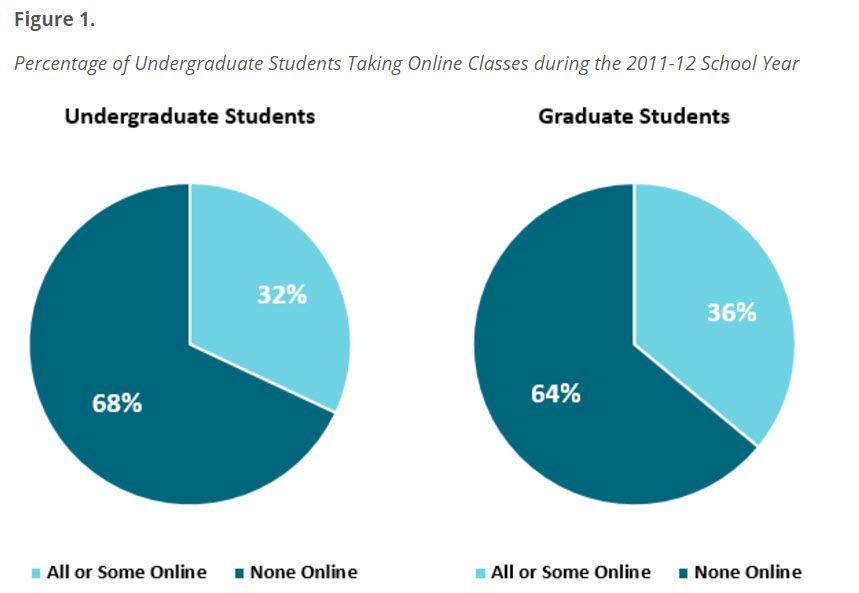
USDOE report finds 32% of undergraduates took an online course in 2011-2012

For the first time, the recently released Digest of Education Statistics 2013 includes statistics on the percentages of undergraduates and graduates who took distance education and online courses. The 940-page Digest, released in May by the National Center for Education Statistics, Institute of Education Sciences, and the U.S. Department of Education makes available statistical information on American education ranging from Pre-K to graduate levels. For information about the distance education statistics, please see our blog post entitled “About 26% of Undergraduates at Degree-Granting Postsecondary Institutions Took a Distance Education Course in 2012-13.”
The data collected to generate the statistics on online learners come from the 2011-12 National Postsecondary Student Aid Study (NPSAS:12), a national study designed to shed light on how students and their families pay for college. As part of the survey, all respondents were asked, “Have any of the courses you have taken at [Institution] during the 2011-12 school year been taught online, at night or on the weekend?” Respondents who answered “yes” to this question were asked more specific follow-up questions, including “Have all, some or none of the classes you have taken at [Institution] in the 2011-12 school year been taught only online?” to which they could reply “all,” “some,” or “none.” To see the Codebook for this survey see http://nces.ed.gov/datalab/powerstats/pdf/npsas2012ug_subject.pdf, specifically variables ALTANY and ALTONLN.
Undergraduate Student Findings
Based on the data collected through these questions, Table 311.20 (p. 454) displays the percentage of undergraduates who took any online classes in 2011-12 was 32.0%, while 8.4% exclusively took online courses. A higher proportion of female undergraduates took any online courses (34.5%) compared to their male counterparts (28.5%). Age was positively correlated with the percentage of undergraduates taking any online courses. Undergraduates ages 15 through 23 were found to have the lowest percentage taking at least one online course (26.5%). Undergraduates ages 24 through 29 had a rate of 36.5%, whereas those ages 30 and older had the highest proportion (40.9%) taking any online courses. There was also variation based on the control of the institution. Undergraduates from private, nonprofit institutions had the lowest percentage taking any online courses (21.0%); about a third of undergraduates from public institutions took any online courses (33.2%); and 35.5% of undergraduates from private, for-profit institutions took any online courses.
Graduate Student Findings
Table 311.30 (p. 455) from the Digest contains the same information, only for graduate students. The percentage of graduate students who took any online classes in 2011-12 was 36.0% while 20.1% exclusively took online courses. A higher proportion of female graduate students took any online courses (39.0%) compared to their male counterparts (31.5%). Similar to undergraduates, age was positively correlated with the percentage of graduate students taking any online courses. Graduate students ages 15 through 23 were found to have the lowest percentage taking at least one online course (19.5%). Graduate students ages 24 through 29 had a rate of 30.8%, whereas those ages 30 and older had the highest proportion (44.3%) taking any online courses. Again, there was also variation based on the control of the institution. Graduate students from private, nonprofit institutions had the lowest percentage taking any online courses (28.5%); about a third of the graduate students from public institutions took any online courses (32.8%); and 74.1% of graduate students from private, for-profit institutions took at least one online course.
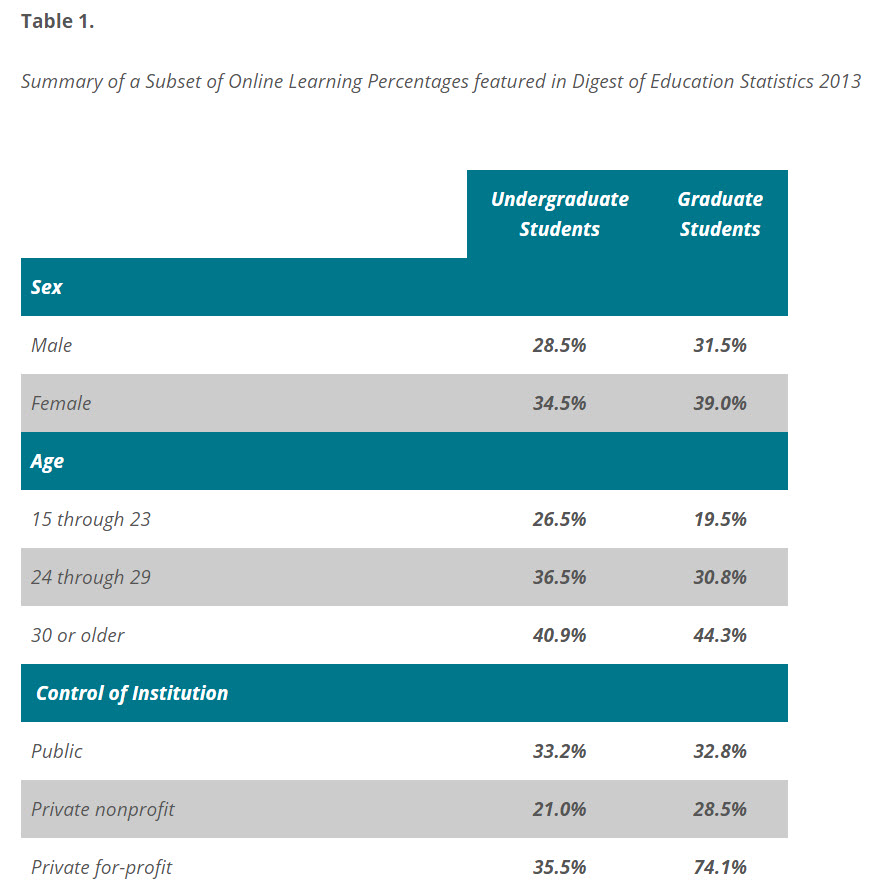
Note: Data for table comes from Table 311.20 (p. 454) & Table 311.30 (p. 455) of the Digest of Education Statistics 2013. Both of the original tables contain additional information about online classes including race/ethnicity proportions.
Conclusion
It is important to note that this data is already three years old and the next NPSAS administration will occur during the 2015-16 school year. Assuming a similar timeframe for publishing the data, it is not likely that an updated figure will come out anytime soon. However, the data do provide important reference points for conversations about college-readiness. If three years ago, a third of undergraduates were taking online courses, that percentage is likely even higher now. And with recent announcements of innovative online approaches such as the University of Florida’s PACE program and Arizona State University’s Global Freshman Academy, there is little reason to think that online learning will not become an increasingly important access option for undergraduate and graduate students. Just another reason why becoming proficient with online learning is a key component of what it means to for K-12 students to graduate college- and career-ready today.

Michigan Virtual Learning Research Institute
The Michigan Virtual Learning Research Institute (MVLRI) is a non-biased organization that exists to expand Michigan’s ability to support new learning models, engage in active research to inform new policies in online and blended learning, and strengthen the state’s infrastructures for sharing best practices. MVLRI works with all online learning environments to develop the best practices for the industry as a whole.
Related Posts

Understanding How Students and Teachers Think About Responsible AI Use: An Interview with a Researcher
Students and teachers generally understand the risks of AI misuse, but they are less clear about what responsible AI-supported learning should look like in practice. This interview highlights findings from a Michigan Virtual study showing that students need clearer examples, consistent expectations, and practical guidance for using AI transparently and appropriately in schoolwork.

What Happens to Students' Online Course Scores After the Course Ends?
The moment an online course ends, a new question begins: how will that score be recorded locally? Drawing on a 2025 brief and a small follow-up survey, this blog post outlines three common approaches districts use to interpret and record students’ online course scores and why the differences can matter for students.

Out of Order, Still Out of Reach: Variations in Pacing among World Language Students
Cuccolo & Green’s (2025) report highlighted the relationship between students’ assignment submission patterns and final course scores. Given that pacing has important implications for student performance, knowing what assignment submission patterns look like across schools with varying demographics could help prompt early identification and intervention. As such, this blog explores students’ assignment submission patterns based on school-level demographic information.

From Curiosity to Career: Exploring Possibilities with VR
Explore how immersive VR simulations helped students step into real-world roles: from EMTs to chefs, all without leaving the classroom.

Out of Order, Still Out of Reach: An Interview with a Researcher
In this blog, MVLRI researchers synthesize the key findings from two research studies about student assignment submission patterns in Michigan Virtual online courses.

Understanding Teacher-Student Communication in Online Courses: An Interview with a Researcher
In this interview, MVLRI researchers discuss key findings from a report highlighting how personalized, consistent, and timely communication in online courses can help students feel more connected to their online teachers and may also impact their success in the course. This blog also explores practical strategies for communicating effectively and building relationships with online students.