
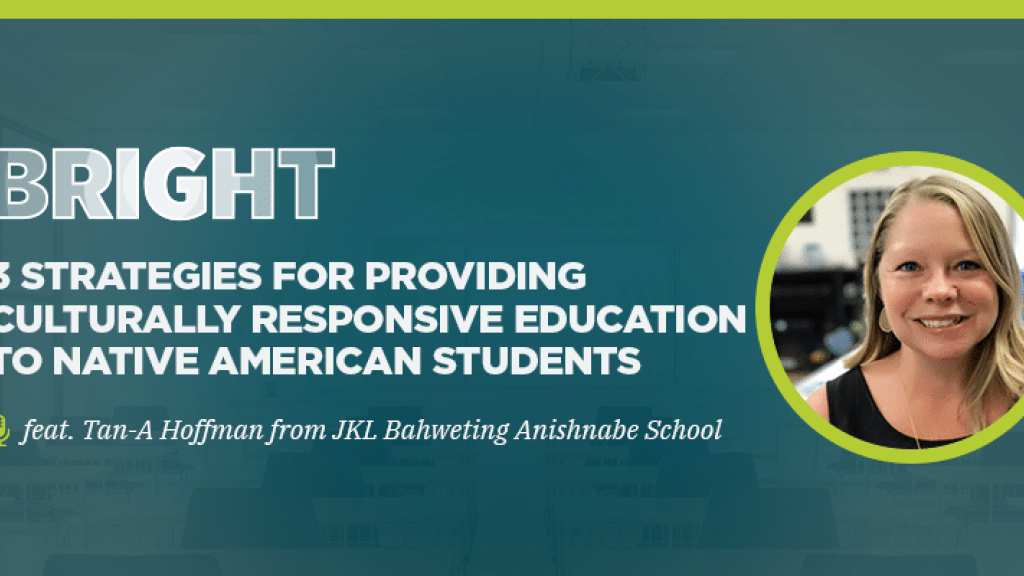
3 strategies for providing culturally responsive education to Native American students

…Or listen on Apple, Spotify, Google, or another platform. Alternatively, you can read along with the transcript.
Wow! I’m so excited to share with you the first episode of our third season of the BRIGHT podcast.
This season, we’re trying something new. Our theme for this season is “3 Strategies.” Basically, what that means is we talk to educators who are experts on a certain topic and ask them to distill their wisdom into the top three things they want the rest of us to know.
To kick off Season 3, I have someone really special to introduce to you. Her name is Tan-A Hoffman, and she’s a second-grade teacher at JKL Bahweting Anishnabe School and a 2020-21 regional teacher of the year, representing her geographic area in Michigan’s upper peninsula.
There were many ways that my conversation with Tan-A challenged me to think more deeply.
“Let’s look at our history books,” she said. “If I’m not from a picture of the 1830s, I am a caricature of myself… I am Anishinaabe not because of the way I look but because of my heart, the things that I know, and the cultural beliefs that I then follow. So, that’s a big deal. When we think about a classroom, erasing these stereotypes is super important because we are invisible in your classroom.”
We are invisible in your classroom.
This statement lingered in my mind for weeks after our initial conversation. Tan-A has blonde hair and blue eyes. She told me that she didn’t get over her “Pocahontas complex” until her early 40s.
“As teachers,” she continued, “it's our responsibility to break down those barriers to help students understand that we are not the past. We are the present… It’s really important that we educate students on the real American history… It matters. It matters to me. It matters to the students in my classroom, and it matters to the communities in which they live.”
We are not the past. We are the present.
In this episode of the BRIGHT podcast, Tan-A shares some incredible stories, a brief bit of history, and three strategies for providing culturally responsive education to Native American students.
You can listen to the full conversation using the audio player above by subscribing to the BRIGHT podcast in your app-of-choice (find us on Apple, Spotify, Google, and more) or by reading along in the transcript.
Here’s a sneak peek at our conversation:
Related resources
Read: Anishinaabe resource manual, created in 2021 by the Confederation of Michigan Tribal Education Departments
Read: Culturally responsive teaching and the brain: Promoting authentic engagement and rigor among culturally and linguistically diverse students by Zaretta L. Hammond
Watch: Rita Pierson: Every child needs a champion (TED Talk)
Watch: Read, Write, ROAR!, an English language arts program for kindergarten through third-grade learners hosted on the Michigan Learning Channel and PBS (Tan-A is one of the program’s third-grade teachers!)
Learn: The Confederation of Michigan Tribal Education Departments
Learn: Anishinaabemdaa, a website dedicated to resources about learning Anishinaabemowin, the language of the Anishinaabe nation

Michigan Virtual
For more than 27 years, Michigan Virtual has partnered with K–12 school districts across Michigan to expand learning opportunities for students and educators alike. Through our high-quality online courses, taught by Michigan-certified, highly qualified teachers, we empower students to learn anytime, anywhere. We also provide affordable, impactful professional development to help educators grow in their craft. Most recently, Michigan Virtual has been at the forefront of innovation and artificial intelligence in education, offering consultation services and professional learning to guide schools in thoughtfully integrating new technologies and learning pathways.
Related Posts
How Students Really Use AI (with Karle Delo from Michigan Virtual)
In a recent episode of Make It Mindful: Insights for Global Learning, host Seth Fleischauer sits down with Karle Delo, AI Strategist at...
Self-Efficacy, Culture, and the Path to AI Adoption in Schools (with Dr. Nikolas McGehee)
In this episode, Dr. Nikolas McGehee talks about how confidence, curiosity, and a supportive school environment influence the way...
AI Can Fix What’s Broken in Schools—If We Do It Right (with Aaron Baughman from Michigan Virtual)
Why Equity, Policy, and Practice Must Evolve Together In this episode of Make It Mindful, host Seth Fleischauer sits down with Aaron...
The Human Side of Systems Change (Part 2) with Dr. Tovah Sheldon
Why Real Innovation Starts With People Educational change often takes a top-down approach—fast, structured, and impersonal. In this...
3 tips for bringing hope into the alternative classroom
Or listen on Apple, Spotify, Google, or another platform. Alternatively, you can read along with the transcript. For students who...
3 things to consider when implementing restorative practices
Getting ready to take restorative practices to the next level in your school community? Check out this list of strategies first!