
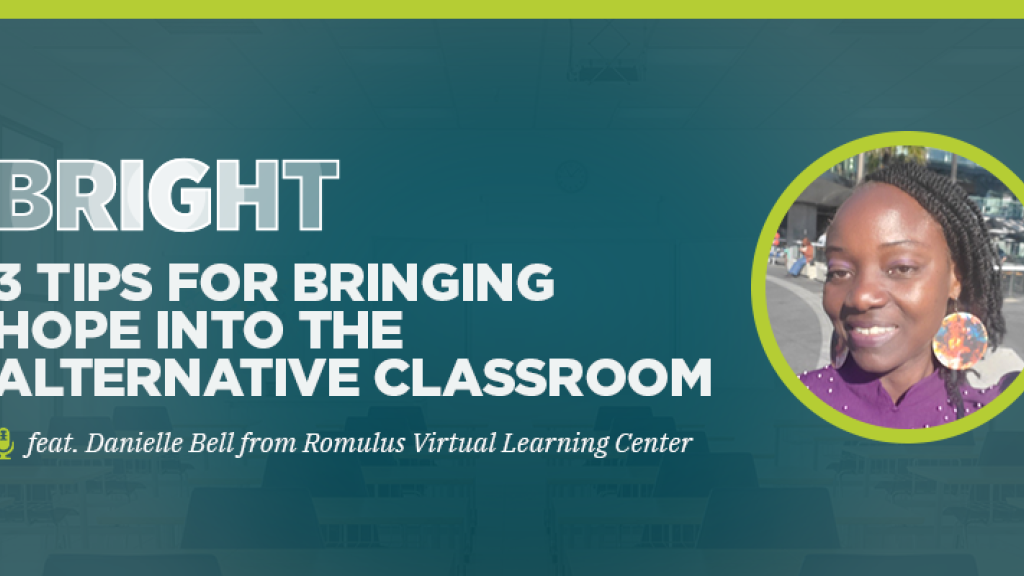
3 tips for bringing hope into the alternative classroom

Or listen on Apple, Spotify, Google, or another platform. Alternatively, you can read along with the transcript.
For students who struggle in the traditional classroom, alternative education programs can offer bastions of hope for the future.
In this episode of the BRIGHT podcast, I chat with Danielle Bell, a teacher for Romulus Virtual Learning Center, who shares:
Common misconceptions about virtual learning,
Why hope is such a critical part of alternative education, and
Her top three tips for fellow educators
You can listen to my conversation with Danielle using the audio player above or by subscribing to the BRIGHT podcast in your app-of-choice (find us on Apple, Spotify, Google, and more) or by reading along with the transcript.
Of course, we understand that educators are busier than ever. If you don’t have time to listen to Danielle’s full episode (which offers the fuller effect of her wisdom, energy, and examples), you can still benefit from a glimpse at her top three tips below.
3 tips for bringing hope into the alternative classroom
#1. Patience is key
Most teaching positions require a great deal of patience.
However, Danielle says you need an extra dose of patience when teaching in an alternative education setting.
Life is challenging for many students who need alterative education. For example, many of Danielle’s students face significant challenges outside of school.
To support them, she sometimes has to extend deadlines and reach out multiple times before an assignment is finally submitted.
The key is being patient without giving up on them. She keeps reaching out — “nagging,” as she calls it — and lets her students know they can and will succeed.
By believing in them, even when they don’t believe in themselves, Danielle gently holds her students accountable for their success even when they feel it’s outside of reach.
#2. Perform wellness checks
According to Danielle, another part of inspiring hope is going beyond academics to check in on your student’s social and emotional well-being.
“Students suffered so much through the pandemic, mentally and psychologically,” she says. “Especially in alternative ed, you have to continue to inspire despite whatever else is going on.”
When students let Danielle know they’re going through personal challenges, she makes sure to check in on them periodically to see how they’re coping.
Sometimes, this just means listening and encouraging. Other times, it means putting a student in touch with professional help, a counselor they can talk to or maybe someone who can help them get a Bridge Card.
At times, Danielle admits, she feels like she’s part social worker, part teacher.
But like any good teacher, she does what’s best for her students even when it’s hard, supporting them as they navigate the balance between life and school and seek a better future for themselves.
#3. Create structure in your classroom
Structure is another key to success in Danielle’s classroom.
Over time, she and her colleagues at Romulus Virtual Learning Center have found that bringing additional touch-points with students leaves them with greater odds of success.
For Danielle, this realization has resulted in scheduling more virtual meetings each week, during which time she can connect with her students and see how they’re progressing in their online coursework.
Because she works in an online setting, students sometimes enter her classroom with misconceptions. By providing a stronger sense of structure for her students, Danielle can clarify these expectations and coach them in the right direction.
“Once you bring the structure in,” she says, “everything else can fall into place.”
My favorite quotes from this episode
“Hope, to me, resonates throughout alternative education.”
“When you're comfortable, you don't usually do as well. But when you're uncomfortable — like I was telling some of my kids recently — that's where you rise up to the occasion. And that's what [Mrs. Lockridge] did for me when it came to writing… Whenever I got in uncomfortable situations when I went to college, even in the work world, I always thought about her and decided not to give up.”
“To see students come into the program who might not be doing well in the beginning, who by the end of the semester have gone up even one letter grade in their classes, that's a big accomplishment. It gives them hope that they can do it next semester, and then, the next semester. And before you know it, they'll be graduating high school.”
Related resources

Michigan Virtual
For more than 27 years, Michigan Virtual has partnered with K–12 school districts across Michigan to expand learning opportunities for students and educators alike. Through our high-quality online courses, taught by Michigan-certified, highly qualified teachers, we empower students to learn anytime, anywhere. We also provide affordable, impactful professional development to help educators grow in their craft. Most recently, Michigan Virtual has been at the forefront of innovation and artificial intelligence in education, offering consultation services and professional learning to guide schools in thoughtfully integrating new technologies and learning pathways.
Related Posts

3 things to consider when implementing restorative practices
Getting ready to take restorative practices to the next level in your school community? Check out this list of strategies first!
3 ways to bring digital literacy into your classroom
This Kalamazoo teacher is passionate about teaching digital literacy skills to the next generation.
3 tips for engaging students in the post-pandemic classroom
This Michigan teacher is changing up her instruction to better meet the needs of her students in the post-pandemic classroom.
3 ways to support students experiencing trauma
Check out this Washtenaw teacher’s go-to strategies for creating a trauma-informed classroom.
3 ways to make your math instruction more equitable
This Detroit teacher is fighting to challenge stereotypes about who is and isn’t “good at math.”
3 tips for starting an esports program at your school
Esports is a billion-dollar industry and growing fast. That’s just one of many reasons this assistant principal from Ludington is giving students who may not otherwise engage in school activities the critical opportunity to be part of a team.