
What makes for quality online teaching? — Revised national standards

By nature, digital learning is constantly evolving. As time goes on, our technologies change and we gain a deeper understanding of how our students learn best in online environments. For online teachers, staying up to date on best practices can be tricky. There’s so much information out there. How can you possibly validate and incorporate it all into your practice?That’s why experts from Quality Matters (QM) and the Virtual Learning Leadership Alliance (VLLA) came together to release a revised version of the National Standards for Quality Online Teaching, which previously had been last updated in 2011 by iNACOL.These national standards were revised based on extensive literature reviews, community feedback via surveys, and the expertise of online learning experts around the globe. Here at Michigan Virtual, we’re honored to have had the opportunity to contribute to the latest edition of these standards.They are truly a collaborative work that represents a consensus from the online learning community on what constitutes quality online teaching.Here’s a sneak peek at the table of contents for the revised National Standards for Quality Online Teaching:
As you can see, these standards are fairly exhaustive in their coverage, including everything from digital citizenship to assessment and measurement. They walk you through best practices for teaching in the online environment. Each standard is broken down to include both explanations and examples, which can help online teachers better understand how they might implement each suggestion into their virtual classroom. For example:
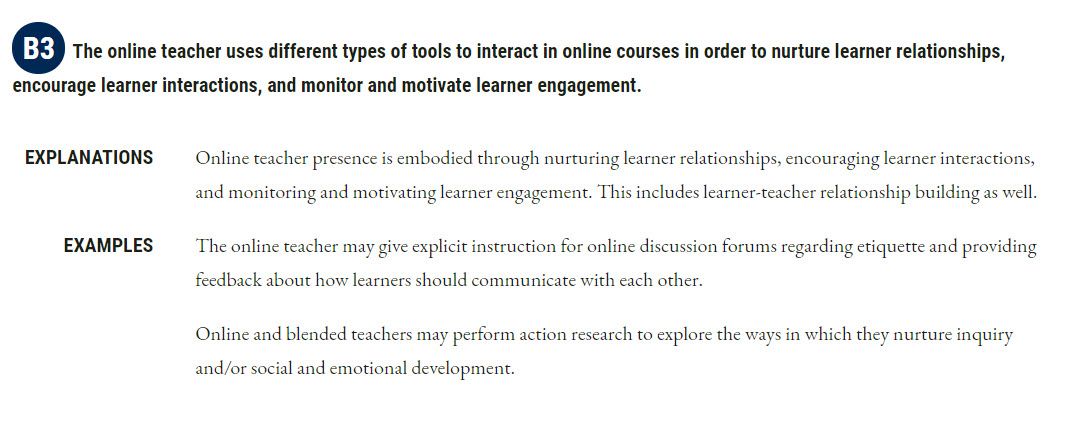
If you’re an online teacher interested in improving your practice, we encourage you to explore these standards and pull out the tips and tricks that are most helpful for you!For more context on how and why these standards were revised, check out the following videos created by Quality Matters and the Virtual Learning Leadership Alliance:
Short Version (6 minutes)
https://www.nsqol.org/wp-content/uploads/2019/08/NSQ-Zoom-r_6-min-2019.08.14.mp4
Deep Dive (27 minutes)
https://www.nsqol.org/wp-content/uploads/2019/08/NSQ-Zoom-r_1920x1080_27-min-2019.08.14.mp4

Michigan Virtual
For more than 27 years, Michigan Virtual has partnered with K–12 school districts across Michigan to expand learning opportunities for students and educators alike. Through our high-quality online courses, taught by Michigan-certified, highly qualified teachers, we empower students to learn anytime, anywhere. We also provide affordable, impactful professional development to help educators grow in their craft. Most recently, Michigan Virtual has been at the forefront of innovation and artificial intelligence in education, offering consultation services and professional learning to guide schools in thoughtfully integrating new technologies and learning pathways.
Related Posts
Have You Considered AI in Your Classroom? A Khanmigo Pilot Story
In a two-phase pilot across Michigan schools, educators used Khanmigo, an AI-powered tutor and teaching assistant, to explore how AI might support teaching and learning. Their reflections surfaced both opportunities and challenges. The big takeaway? AI has potential, but only with intentional support.

From Curiosity to Career: Exploring Possibilities with VR
Explore how immersive VR simulations helped students step into real-world roles: from EMTs to chefs, all without leaving the classroom.

Understanding Teacher-Student Communication in Online Courses: An Interview with a Researcher
In this interview, MVLRI researchers discuss key findings from a report highlighting how personalized, consistent, and timely communication in online courses can help students feel more connected to their online teachers and may also impact their success in the course. This blog also explores practical strategies for communicating effectively and building relationships with online students.

Key Strategies for Supporting Disengaged and Struggling Students: An Interview With A Researcher
In an era where virtual learning is becoming increasingly prevalent, understanding the best practices for engaging students online is...

16 Holiday Gift Ideas for the Online Teachers in Your Life
A list of 16 gift ideas to make the online teaching experience easier, better, and, yes, more fun!

District Plans for Shifting to Remote Instruction in Spring 2020
Should we go fully digital, use paper copies, or use a hybrid model? How will we assess the technology needs of our students? Should we arrange for meal pick up, delivery, or some combination? How will we manage and monitor student learning? How will we continue to meet the social-emotional needs of our students? These are just some of the questions that school leaders faced as they developed their plans for continued learning after school doors were shuttered for the year due to the coronavirus pandemic.