

Step-by-step guide to setting up a successful online summer learning program

Step-by-step guide to setting up a successful online summer learning program
If you’re an administrator or school counselor, maybe this story rings familiar:Students and parents in your school or district are coming to you asking for summer learning options. Of course, you want to offer them summer learning options. In a perfect world, you’d give them everything they need to succeed and more.But perhaps, you’re struggling to find the budget and staffing capacity required to create a sustainable summer school model.One of the benefits of setting up an online summer learning program is that you can have your cake and eat it, too, by:
Providing students with a robust array of summer learning opportunities
Improving graduation rates at your school by allowing students to participate in summer credit advancement or credit recovery
Accomplishing all of this while designing a system that is cost-neutral or revenue-positive
If you’re looking to provide students at your school or district with more summer learning options, this step-by-step guide will help you think through the process of building a highly successful online summer learning program. What questions do you have about summer learning? Explore answers in: "Summer Learning FAQs (with advice from Michigan districts who are doing it well!)"
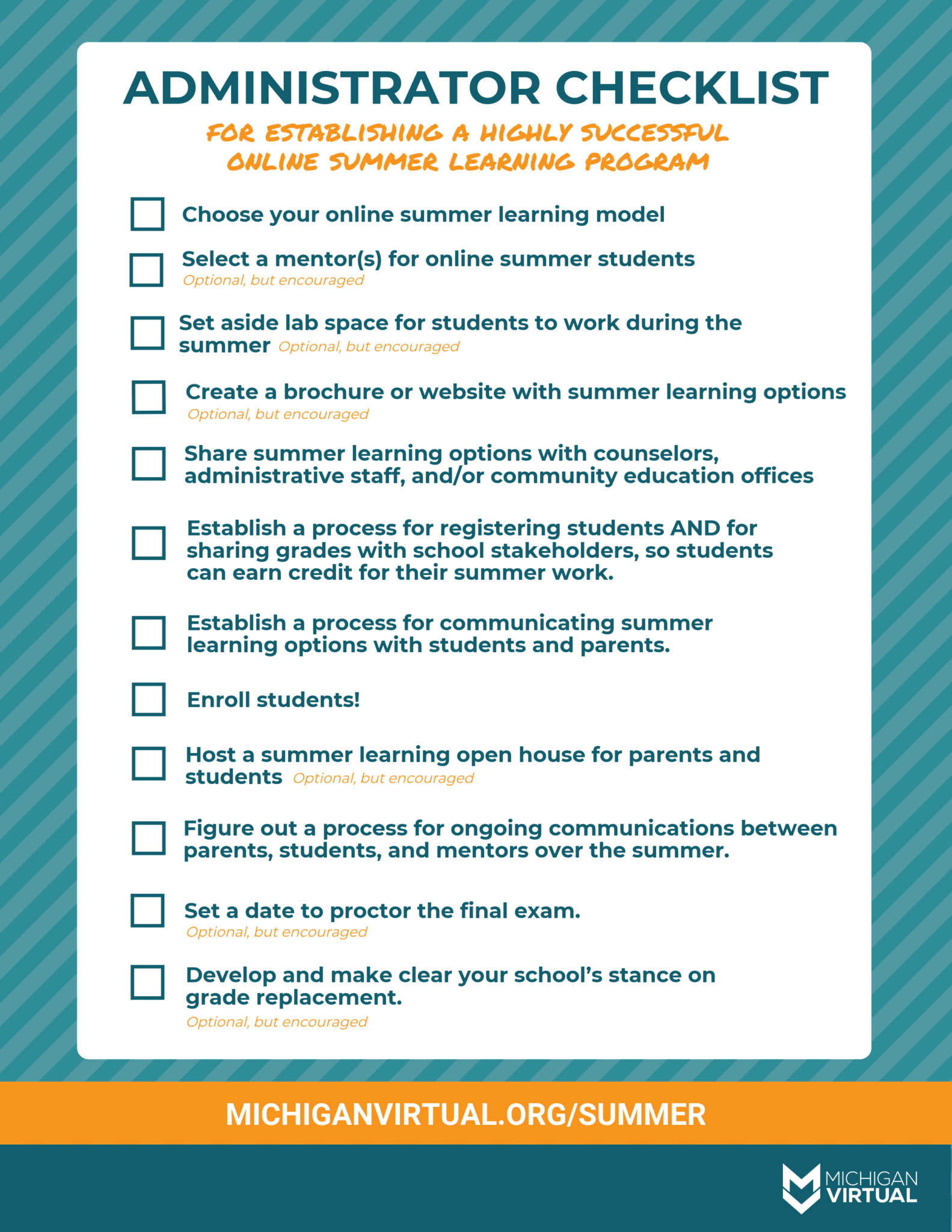
STEP ONE: Choose your online summer learning model

There are many different ways to run an effective online summer learning program. Every year, we work with schools across the state of Michigan to offer their students online summer courses, and each school does it a little bit differently. Here are the most common models we see schools using:
Model #1 — Parent- or student-led approach
Some of the schools we work with choose to take parent- or student-led approach to offering online summer learning programs. What this means is they allow students to earn credit for taking online summer courses, but provide few school-sanctioned supports (e.g., a mentor, lab space, or proctored exam). In this model, parents and students are the primary responsible units for ensuring student success.
Model #2 — School-sponsored, minimal supports provided
Other schools take a more active role by encouraging students to take online courses over the summer and providing students with some supports to help them succeed. Often times, the schools using this model will actively promote summer learning options to students through school counselors or schoolwide communications. A mentor may be paid a stipend to work remotely to check in with parents and hold students accountable for completing their coursework, but a lab space is typically not provided for students to work.
Model #3 — School-sponsored, highly supportive
The model that often yields the highest student outcomes is a school-sponsored online learning program with high levels of student support. In this model, the school pays a mentor or several mentors (depending on program size) to run a summer lab space where students have the option to come work on their online coursework. This mentor serves an active role in holding students accountable and also provides a safe, positive learning environment with stable internet access. To fund these student supports, schools using this model typically ask parents to pay for summer courses and raise the price of each course to cover the cost of paying mentors and keeping a lab space open during the summer.
Which model is most conducive to student success?
You can find student success in any of these models, but generally, we see the highest and most consistent student outcomes in schools who use Model #3. Why? Because we know from research that online learners perform best when they receive the appropriate supports. Before continuing the rest of the steps in this guide, you may want to start thinking about which model will work best for your school.
STEP TWO: Select mentor(s) for online summer students

Optional, but encouraged
When it comes to online learning, mentors play a critical role in student success. While some parents do a great job at supporting their online learners and holding them accountable for completing their summer coursework, we generally find higher student outcomes in schools that invest in paying a mentor — or several mentors, depending on the size of their summer program — to monitor and support online learners.To learn more about what an online mentor is and why they’re so critical to the success of online learners, visit our mentor page.
STEP THREE: Set aside lab space for students to work during the summer

Optional, but encouraged
While this step is not strictly necessary, we generally recommend that schools set aside lab space for students to come work on their online coursework over the summer. Having a computer lab open during the summer provides students a positive learning environment. This is particularly important if students have a distracting home environment, trouble with time management, or an unstable internet connection.Typically, mentors make themselves available during lab time to support online learners. Some schools keep lab space open every day during typical school hours. Others set aside one or two days per week for students to come work on their coursework with their mentor.
STEP FOUR: Create a brochure or website with summer learning options

Optional, but encouraged
If you are offering summer learning options to students at your school, it can be helpful to create a brochure or website that overviews what options are available to them and how they should go about registering and receiving credit for their courses. For schools who partner with us to offer summer online courses, we create a co-branded brochure at no cost that highlights summer offerings available to students as well as key registration information.
STEP FIVE: Share summer learning options with counselors, administrative staff, and/or community education offices

Before getting too far in planning your online summer learning program, make sure to involve key stakeholders, such as school counselors, administrative staff, and/or community education offices. First off, it’s important that they are aware of the summer learning options available to your students. Secondly, if you involve them early on in the process, they may provide you with valuable feedback and help you solidify and optimize key processes!
STEP SIX: Establish a process for registering students AND for sharing grades with school stakeholders, so students can earn credit for their summer work.

This part is pretty important. . . Before communicating learning options to students and parents, make sure you’ve created a tried-and-true registration and credit submission process that will work well for all key stakeholders. You’ll want to make sure that it’s perfectly clear how students and parents should enroll in their online summer courses AND how they will receive credit for completed coursework.
Questions to consider:
Who will be enrolling students in online summer courses? Parents? Counselors? Someone else?
Who will be paying for summer courses? If the school is enrolling students, but parents will be paying for courses, how will you capture their payment information?
How will parents/students share course completion certificates with your school to ensure students earn credit for completed coursework?
STEP SEVEN: Establish a process for communicating summer learning options with students and parents.

Next step! Communicating summer learning options with students and parents at your school or district!
There are may communication channels you can use to accomplish this goal:
A webpage that provides all key information relevant to summer school, including course offerings, registration information, and who you should contact if you have questions.
Emails to students and parents
Flyers posted around your school
Brochures available in the school counselor and/or principal’s office
Social media postings
Snail mail to parents
And more!
To avoid any confusion, you may even consider creating a list of FAQs on your school’s website. One school who has done a great job communicating summer learning options to students is Northville Public Schools with their summer programs webpage.For schools who offer online courses over the summer, we’ve created a summer school communication kit to help them spend less time writing communication materials and more time doing what they do best — helping students! Check it out!
STEP EIGHT: Enroll students!

This is where you really begin to see the fruits of your labor! If you are having a school counselor or program administrator do the enrolling, this is where they take over and make sure all students are enrolled in the appropriate online courses. Otherwise, if parents/students are doing the enrolling themselves, all you have to do is wait patiently for the numbers to roll in. . .
STEP NINE: Host a summer learning open house for parents and students.

Optional, but encouraged
One strategy that we have found to be particularly effective is hosting a summer learning open house for parents and students. This open house doesn’t have to be anything extensive, but it can be incredibly helpful to set aside a one-hour informational session and Q&A for students and parents interested in online summer learning.
A few helpful topics you might cover during this open house include:
What is online learning? What does it look like from the perspective of an online learner?
Where do students log in to their online courses?
How do parents view their student’s progress?
How should students submit completion certificates to earn credit for their summer courses?
How can students be successful in their online learning?
As a parent, how should I best support my online learner?
What is the role of the mentor? — If applicable
Why and when should students attend lab time? — If applicable
Why do students need to have their final exam proctored — If applicable
If you’re unsure about the answers to some of these questions, you can find many tips, tricks, and best practices in our free guides to online learning.If you are using our courses to power your summer learning program, we encourage you to share our Student Quick Start Guide and Parent/Guardian FAQs with students and parents as well.
STEP TEN: Figure out a process for ongoing communications between parents, students, and mentors over the summer.

Optional, but encouraged
This step is important because, in our experience, we have found that student pass rates significantly improve when parents receive regular updates from a mentor on their student’s progress. Having a third party involved in this process helps keep students more accountable and on track to complete their coursework on time, rather than rushing to finish the bulk of their work in the last week of the semester. Talk to your mentor(s) ahead of time to make sure they have a process in place for communicating with parents and students about student progress!
STEP ELEVEN: Set a date to proctor the final exam.

Optional, but encouraged
Some schools with online summer learning programs choose to have each student’s final exam proctored to ensure the validity of exam results. In our online courses, we take great strides to ensure the academic integrity of student submissions, relying on the expertise and critical eyes of our online teachers and advanced online teaching tools that monitor plagiarism. Proctoring the final exams of online learners, however, does add an extra layer of security to ensure all students have fully mastered the content they studied in their online summer course.
STEP TWELVE: Develop and make clear your school’s stance on grade replacement.
Especially when it comes to credit recovery, students and parents often have questions about whether or not the grade received in their summer online course will replace the grade they received when taking the course in a previous semester or school year. To prevent students and parents from being frustrated if they are unable to replace their grade, it is best to develop a policy on grade replacement and communicate this policy clearly to parents, students, school counselors, and other key stakeholders up front.
Concluding thoughts
Well, there you have it. While perhaps not exhaustive, we hope this step-by-step guide has helped you start thinking of ways to set up an effective online summer learning program in your district or improve your existing program. If you’re curious to learn how other schools have gone about creating highly successful summer learning programs for their students, check out this webinar recording where we talk to representatives at Brighton and Northville schools about what they've found effective in their programs.
Other resources you might find helpful:
Summer Learning FAQs (with advice from Michigan districts who are doing it well!) [Blog article]
7 ways taking online summer course benefits your high-achieving students [Blog article]
How to prevent the “summer slide” without giving up your hard-earned break [Blog article]
10 Reasons Students Take Our Online Summer Courses [Infographic]
4 Types of Online Courses Your Students Can Take This Summer [Infographic]
Empower your students to learn this summer with the help of a highly qualified, Michigan-certified instructor!
This summer, we’re offering online courses on over 150 different subjects, including core areas (i.e., science, math, English, and social studies), as well as a myriad of fascinating, career-oriented electives. Students have 10 weeks to complete summer coursework at their own pace and will be supported along the way by a highly qualified, Michigan-certified online instructor who is an expert in their subject area. These courses provide a flexible opportunity for students to recover credits or fulfill requirements in advance of graduation while keeping their minds active over the summer!You can learn more about our summer learning options at michiganvirtual.org/summer
Interested in setting up an online summer program powered by Michigan Virtual?
Fill out the form on this page and one of our representatives will get in touch with you!

Michigan Virtual
For more than 27 years, Michigan Virtual has partnered with K–12 school districts across Michigan to expand learning opportunities for students and educators alike. Through our high-quality online courses, taught by Michigan-certified, highly qualified teachers, we empower students to learn anytime, anywhere. We also provide affordable, impactful professional development to help educators grow in their craft. Most recently, Michigan Virtual has been at the forefront of innovation and artificial intelligence in education, offering consultation services and professional learning to guide schools in thoughtfully integrating new technologies and learning pathways.
Related Posts

Top 10 reasons students choose online summer credit recovery
When a student fails a class — or perhaps multiple classes — they may come to the realization that taking classes over the summer is the only way they can graduate on time with the rest of their peers. For students facing this situation, taking summer courses online can be a great way to recover the credits needed for graduation without missing out on their existing summer plans.

Summer Learning FAQs (with advice from Michigan districts who are doing it well!)
Summer brain drain isn’t a myth. On average, it is predicted that students lose about one month’s worth of learning over the summer.

7 reasons why your high-achieving students deserve online summer learning options
For self-motivated learners, taking online summer school courses can be liberating because it allows them to make progress toward their goals while studying at their own pace in time blocks that fit their busy schedules. In some cases, online programs offer students more learning options with more flexibility than their face-to-face counterparts.

How to avoid the "summer slide" without giving up your hard-earned break
In this blog post, we’ll cover the basics of the summer slide — what and who are at risk and why — as well some tips and tricks for mitigating the effects of summer learning loss.