

Unlocking the Next Level of Science Teaching
I’m not ashamed to admit it — I’m 34, married with three children and I still like to play video games.
 While the Sega Genesis gave birth to my addiction, I do vividly recall huddling around the Commodore 64 with my four older brothers, taking turns playing games like Kung Fu, Frogger, Spyhunter and Paperboy. I also vividly remember my older brother Jimmy grabbing the joystick after losing a game and slamming it against the wall, breaking our best controller in half. In his defense: 1) he had an anger problem, and 2) video games back then were hard — I mean really, really hard. If you don’t believe me, go ahead and watch a play through of the notoriously incomprehensible Atari video game, E.T.
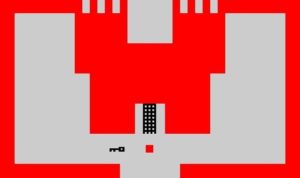
Teaching is hard too. And sometimes I feel like I am wandering through a complex maze (à la Atari’s Adventure) trying to find just the right key to unlock the next level of learning for each of my students. For many of us science teachers, the updated Michigan Science Standards add a new layer of complexity and can leave us feeling overwhelmed, like using the whistle to skip right to Super Mario 3’s World 8. I often feel especially sympathetic toward our elementary teacher colleagues who must manage their self-contained classrooms with the dexterity of a teenager playing Call of Duty — keeping track of all 14 buttons on their XBOX controller simultaneously.
Honestly, all of us need help in finding the keys to unlock the door on learning. In video game parlance, we need a “walkthrough” — a guide that shows us the right way, the right door, the right key and the tips and tricks that can help us slay the dragons (just to be clear — by dragons, I don’t mean the students, but the misconceptions students bring with them to class... perhaps it's time to drop the video game analogy).
We here at Michigan Virtual have been working in partnership with the Science, Mathematics, Technology Center at Central Michigan University to build precisely that kind of “walkthrough” for K-5 science teachers. The project is called Phenomenal Science and it includes two central components:
- A complete K-5 science curriculum that is aligned to the new Michigan Science Standards, and
- A series of free online professional learning courses to train educators in the principles, strategies and structure of this new curriculum
As a preview of the curriculum and associated training, below we have assembled five of the key principles and strategies embedded in the Phenomenal Science units. These “keys” can help unlock the next level of science teaching at any grade.
Phenomena-Based Engagement
In every lesson, students encounter a puzzling event from the real world that they are challenged to explain. Students develop their own explanation through applying Science and Engineering Practices, building a deep understanding of underlying science ideas. Through this active engagement, students must develop their own concept of the scientific phenomena under investigation.
Making Thinking Visible
Throughout each lesson, particularly while engaged in the practices, students will make their thinking visible to the teacher and especially for peers. This allows for ready comparison of planning, data and evidence and their interpretation. Making thinking visible happens particularly when engaging students in instructional strategies such as the modeling instructional sequence, summary tables, KLEWS Charts and C-E-R.
Science Notebook
It is recommended that teachers require students to use a science notebook to support learning. A major goal of a science notebook is for students to develop the ability to collect data, make sense of it, and share it with others. Using science notebooks with students requires advanced planning to ensure they are managed well and used effectively.
Talk Moves / Science Discourse
Students build science understanding of concepts through processing of hands-on investigations and activities. Their first mode of processing is talk. Having collaborative norms in place and using sentence frames to help guide the discussions are critical. Planning for the key questions a teacher will need to guide the meaning-making discussions is also critical.
Integration of ELA / Math / Technology
One of the best recommendations for finding time to teach science (while still devoting time to ELA and Math) is to integrate all subjects around science experiences. We find that students' understanding is greater in all subjects when their learning journey begins with a science experience, which is then built upon synergistically through ELA and Math. As a result, Phenomenal Science has intentionally integrated speaking, listening, reading, writing, and math around real science, technology, and engineering experiences.
Related Posts
Evaluating and Maximizing Professional Learning: An Interview with a Researcher
This blog digs into the key findings from two MVLRI research studies exploring educator engagement with professional learning (PL), their beliefs about implementing what they’ve learned, and insights into continuing to tailor PL to meet educators’ needs.
Creating a Culture of Continuous, Collaborative, and Personalized Professional Learning
Not only is the professional learning happening within Michigan's Grand Ledge Public Schools continuous and collaborative, it is also rooted in their strategic plan, reflective of their beliefs about student learning, and personalized to fit the unique needs of each staff member.
Street Data and Empathy: Revealing What Educators Truly Want from Professional Learning
What do educators actually WANT out of their professional learning experiences? This is a question my colleague Danielle, who contributed...

A Framework for Empathy: 3 steps leaders can follow to center educators’ Needs and Wants
Part 1 of this blog series digs into the results of a survey on what educators need and want from their professional learning experiences. Here in Part 2, we show you the framework we used to create and conduct the survey as well as provide you with ideas for implementing this framework in your own context. Special thanks to my colleague, Danielle Peck, who contributed significantly to this study and the writing of these blogs.

Effective Practices in Professional Learning Course Design: Course Content
Based on direct input from learners via end-of-course survey data, Michigan Virtual’s Instructional Product Development team gleaned the effective practices outlined in this blog in order to improve their course development and better meet the needs of the educators whom they serve.

Effective Practices in Professional Learning Course Design: Assessments, Format, Structure, and Appearance
Based on direct input from learners via end-of-course survey data, Michigan Virtual’s Instructional Product Development team gleaned the effective practices outlined in this blog in order to improve their course development and better meet the needs of the educators whom they serve.