
Teaching in Beta

My colleagues, Kelli Hixon and Stacey Schuh, regularly facilitate blended learning regional events across the state. In most cases, they’ve partnered up with intermediate school districts (ISD’s) throughout the state to help host and promote the events. A great result of this collaboration is that they get a great mix of teachers from the local districts that each ISD serves.
I was fortunate to fill in for Stacey at an event this week at Jackson ISD for secondary teachers. At the core of these two-day events is a project-based lesson: Plan a blended lesson you could use in your classroom.
On the first day, Kelli set the stage for blended lesson planning by introducing teachers to the holistic mindset for blended learning design.
https://www.youtube.com/watch?v=OYFEDR2qlBc
The discussions that follow are awesome. Common refrains include how they can see themselves adding this mindset to how they already plan and many teachers discuss how they might make different decisions than what is modeled in the video example. It’s interesting to hear the conversation shift from different educational tools to pedagogical need and descriptions of digital tools that could potentially support those pedagogies!
Continuing throughout the first day and into the second, Kelli demonstrates a few tools and gives teachers ample time to explore an extended list of similar tools. Teachers explore using the tools within the context of building collaborative activities, rich learning content and formative/summative assessments for their blended lessons.
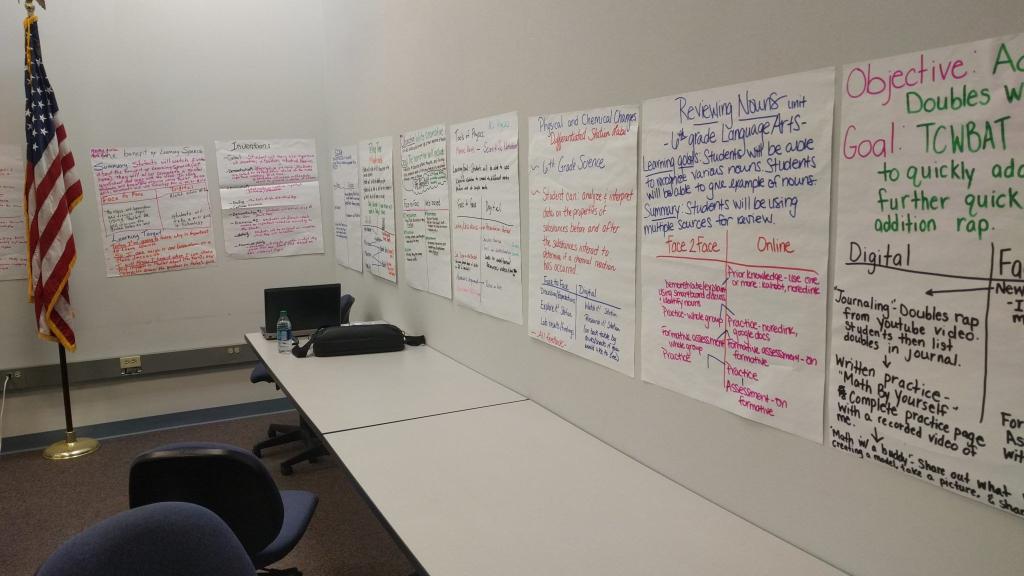
In the afternoon of their final day together, teachers synthesize their lesson development onto a poster. The posters give a top-level overview of the content and learning targets for each lesson. Teachers conduct a gallery walk; one last opportunity to learn from each other and provide feedback. You can see some photos I captured from the gallery walk here.
These are still rough drafts that will continue to evolve before teachers use them with students and there will be more opportunities for improvement after the student experience as well. As teachers, we live in beta. We need to be open to the learning opportunities that come about from sharing unfinished work. The work is never finished after all. Lessons are living things. But when shared, the can be used by other teachers and grow in effectiveness through their revisions as well.
In the spirit of this, please take a look at the gallery walk posters and share your feedback. We’ll make sure that the lesson creator gets it!

Jeff Gerlach
Jeff is passionate about helping teachers enhance learning for students by way of strategic technology integration. This fuels his work as an instructional design coach. Prior to his time at Michigan Virtual, Jeff was a social studies teacher for six school years and he earned a master’s degree from Michigan State University in educational technology. Away from the education world he enjoys spending time at the ice rink, at home with his young family and head nodding to hip-hop music.
Related Posts
Project-Based Learning and Competency-Based Education Work Together at FlexTech: An Interview with an Educator
By blending project-based learning with competency-based education, FlexTech aims to provide a personalized path to graduation, meeting both academic standards and students’ personal growth goals.
Evaluating and Maximizing Professional Learning: An Interview with a Researcher
This blog digs into the key findings from two MVLRI research studies exploring educator engagement with professional learning (PL), their beliefs about implementing what they’ve learned, and insights into continuing to tailor PL to meet educators’ needs.
Creating a Culture of Continuous, Collaborative, and Personalized Professional Learning
Not only is the professional learning happening within Michigan's Grand Ledge Public Schools continuous and collaborative, it is also rooted in their strategic plan, reflective of their beliefs about student learning, and personalized to fit the unique needs of each staff member.

Street Data and Empathy: Revealing What Educators Truly Want from Professional Learning
What do educators actually WANT out of their professional learning experiences? This is a question my colleague Danielle, who contributed...

A Framework for Empathy: 3 steps leaders can follow to center educators’ Needs and Wants
Part 1 of this blog series digs into the results of a survey on what educators need and want from their professional learning experiences. Here in Part 2, we show you the framework we used to create and conduct the survey as well as provide you with ideas for implementing this framework in your own context. Special thanks to my colleague, Danielle Peck, who contributed significantly to this study and the writing of these blogs.

Effective Practices in Professional Learning Course Design: Course Content
Based on direct input from learners via end-of-course survey data, Michigan Virtual’s Instructional Product Development team gleaned the effective practices outlined in this blog in order to improve their course development and better meet the needs of the educators whom they serve.